
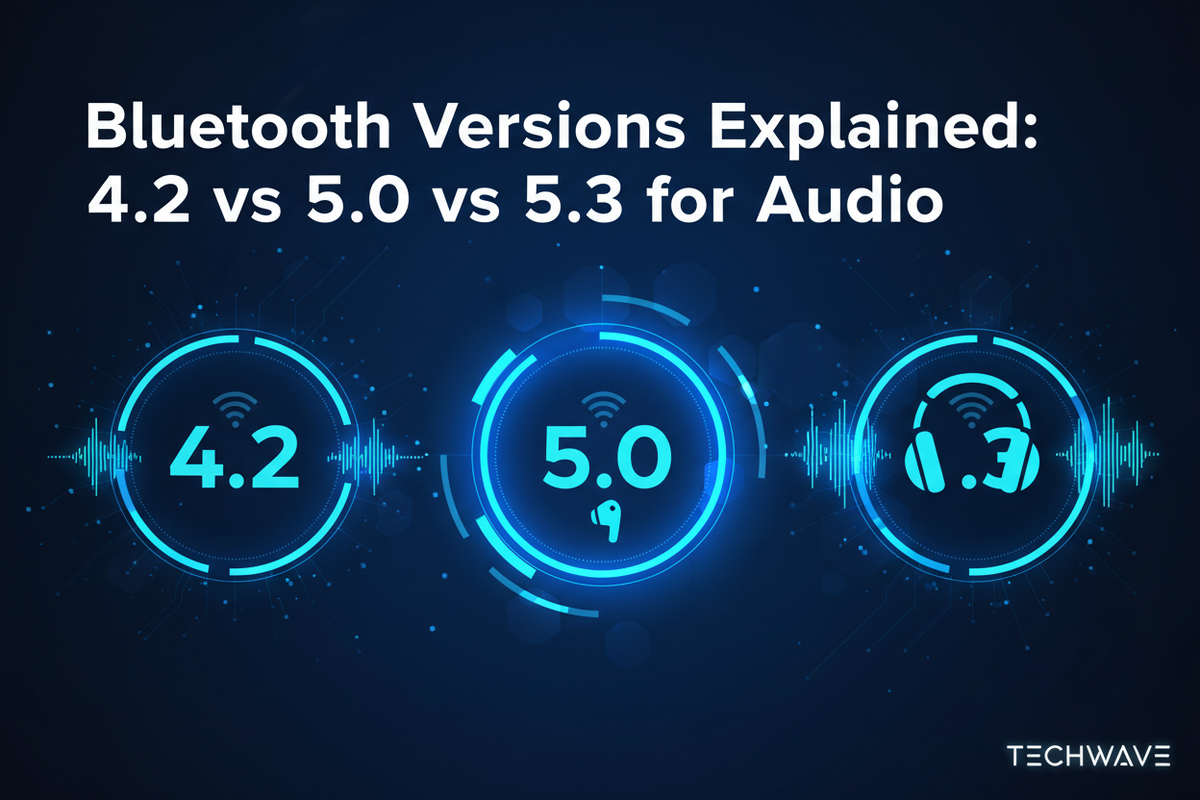
Wireless audio has moved well beyond simple music playback. A modern bluetooth speaker may be used for movies, streaming, gaming, podcasts, and everyday listening, where connection stability and timing can matter just as much as sound quality.
When dialogue arrives slightly behind the image, a game sound effect feels late, or a soundtrack loses its impact, the problem may not be the Bluetooth connection alone. Wireless performance is the result of several systems working together: the Bluetooth connection, codec, source device, latency behavior, driver response, enclosure, and acoustic tuning.
That makes terms such as Bluetooth 5.3, codecs, and latency worth understanding before choosing a speaker.
For anyone considering a wireless bluetooth speaker for movies or gaming, the important question isn't simply whether a speaker has the newest Bluetooth version. It is how effectively the complete system turns a wireless audio signal into controlled, synchronized sound.
Bluetooth 5.3: What It Actually Means for Wireless Audio

Bluetooth 5.3 is primarily a wireless communication specification. It should not be confused with a specific sound signature or automatic improvement in audio quality.
The Bluetooth version affects how compatible devices communicate, while the speaker's driver, enclosure, amplifier, DSP, and acoustic architecture determine how that transmitted signal ultimately sounds.
For a rechargeable bluetooth speaker, a modern Bluetooth implementation can contribute to a more dependable everyday experience through improvements in connection management and power efficiency.
In practical use, buyers are generally looking for:
- Stable wireless playback
- Reliable pairing
- Fewer connection interruptions
- Efficient power use
- Consistent communication between source and speaker
However, Bluetooth 5.3 by itself does not guarantee better bass, better imaging, or better tonal balance.
A useful way to think about it is:
Bluetooth carries the information. The speaker has to reproduce it.
That distinction becomes particularly important when comparing portable speakers that advertise similar wireless specifications but use very different acoustic designs.
For a broader look at Bluetooth generations, see UB+'s Bluetooth 4.2 vs 5.0 vs 5.3 guide.
Codecs: The Part of Bluetooth Audio People Often Overlook

Bluetooth audio generally relies on codecs to encode and decode audio data for wireless transmission.
A codec essentially determines how audio information is represented and transmitted between compatible devices. Different codec implementations can involve different approaches to compression, data rate, compatibility, and latency.
This matters because movie soundtracks and games contain more than continuous music. They include dialogue, transient effects, quiet passages, environmental details, and sudden changes in dynamic intensity.
A wireless system needs to preserve those changes convincingly.
But codec performance should not be considered in isolation.
Even when the wireless signal arrives correctly, the speaker still has to reproduce it through a physical acoustic system. A poorly controlled enclosure can introduce coloration or resonance that has nothing to do with the codec itself.
This is why a speaker's wireless specification should always be considered alongside:
- Driver design
- Enclosure geometry
- Resonance control
- Amplification
- DSP implementation
- Sound dispersion
The best sounding bluetooth speaker is therefore not necessarily the one with the longest specification list. The entire signal path has to work together.
Latency Is Critical for Movies and Gaming

Latency is the delay between an audio signal being transmitted and the corresponding sound being produced.
For music listening, small timing differences may be difficult to notice. Movies and games are less forgiving.
Imagine watching someone speak on screen while the voice arrives slightly afterward. Or imagine seeing a game character fire a weapon before hearing the corresponding sound effect.
The audio may still be high quality, but the experience feels disconnected.
Latency can be influenced by multiple stages of the wireless chain, including:
- The source device
- Bluetooth transmission
- Codec processing
- Receiving hardware
- Digital signal processing
- Amplification
- Driver response
This is why Bluetooth 5.3 should not automatically be interpreted as "zero latency." The complete system determines perceived synchronization.
For movie-focused setups, UB+'s guide to fixing Bluetooth audio delay for movies provides another useful reference.
Why Acoustic Design Still Matters to Timing
Wireless latency is primarily a signal-chain issue, but acoustic behavior can also affect how cleanly timing cues are perceived.
A speaker that produces excessive resonance can allow certain frequencies to linger. Bass notes, in particular, can become less defined when the enclosure or tuning allows energy to continue after the original transient.
This doesn't mean an enclosure can eliminate Bluetooth transmission latency. It means the physical speaker should reproduce the incoming signal with controlled behavior once the signal reaches it.
That distinction is important for cinematic sound.
A kick drum, explosion, door closing, or game effect contains transient information. Controlled mechanical behavior helps those events remain distinct rather than becoming blurred by unwanted resonance.
The Overlooked Question: How Is Bass Actually Produced?

Movie soundtracks and games depend heavily on low-frequency information.
Explosions need weight. Music needs foundation. Engines, footsteps, impacts, and environmental effects can all contain significant low-frequency energy.
Many compact speakers use DSP to shape their response within the limitations of a small enclosure. DSP can be useful for protection, tonal balance, linearity, and driver control, but physical acoustic design remains important.
The UB+ dB1 DOUBLEBASS takes a different approach to low-frequency reproduction.
Its architecture combines a spherical acoustic chamber inspired by the Helmholtz resonator concept with a centrally positioned mid-bass driver and dual passive radiators.
The objective is to use the air volume and enclosure as active parts of the acoustic system rather than treating the cabinet as a passive container.
This is particularly relevant when evaluating portable bluetooth speakers with good bass, because deep bass isn't simply a matter of increasing amplifier power.
Why the dB1 Uses a Spherical Acoustic Chamber
Traditional speaker cabinets are commonly rectangular. That shape is practical for manufacturing and packaging, but parallel internal surfaces can create repeated reflections and standing-wave behavior.
The dB1 approaches the enclosure differently.
Its true spherical enclosure is designed around the movement and distribution of air pressure. Without conventional parallel internal walls, the chamber provides a different acoustic environment for the driver and passive radiators.
The result is intended to support:
- More even internal pressure distribution
- Reduced standing-wave behavior
- Controlled resonance
- Improved harmonic reproduction
- Broad sound dispersion
The sphere therefore isn't simply a visual design decision.
It is part of the acoustic architecture.
For a deeper explanation of this approach, UB+'s spherical Bluetooth speaker design article explores how the enclosure functions as an acoustic component.
The DoubleBass Architecture: Air Does More of the Work
The dB1's defining feature is its symmetrical passive-radiator system.
Inside the speaker, a centrally positioned mid-bass driver fires into the spherical chamber. Rather than simply projecting the driver output directly toward the listener, the driver energizes the internal air volume.
That pressure then interacts with two large passive radiator plates positioned on opposite sides.
The basic sequence is:
Driver movement → internal pressure → symmetrical radiator movement → acoustic output
The two radiators move in opposite directions. This opposing motion helps balance mechanical forces and reduce unwanted cabinet movement.
The combined passive-radiator surface area is approximately 3.5 times the surface area of the woofer, providing substantial moving area for low-frequency air displacement.
This is a mechanical approach to bass generation rather than simply asking the amplifier and driver to work harder.
Most speakers try to push harder. The dB1 lets air do the work.
Why Mechanical Stability Matters
A speaker doesn't convert every bit of electrical energy into useful sound.
Some energy can become unwanted mechanical movement. If the cabinet moves significantly, part of the system's energy is effectively being spent moving the enclosure instead of moving air acoustically.
The dB1's opposing passive radiators are designed around a self-balancing mechanical arrangement.
As one radiator moves in one direction, the other moves in the opposite direction. The forces therefore work against each other rather than producing the same directional cabinet movement.
That matters for movie and gaming content because low-frequency effects can be demanding.
A stable enclosure helps the speaker maintain its intended acoustic behavior as bass energy increases.
Driver Construction Matters Too
The enclosure cannot work alone. The driver has to handle the demands placed on it.
The dB1 uses a 4.5-inch mid-bass driver with components including:
- 90 mm neodymium magnet
- 35 mm long-stroke voice coil
- Extended piston movement
- Aluminum shorting ring
- Wide surround
These elements are intended to maintain controlled driver movement and reduce distortion during demanding passages.
For entertainment listening, that matters because movies and games can shift rapidly between quiet dialogue and high-energy effects.
A speaker that sounds balanced during background music still needs enough control to handle sudden transients without becoming harsh or congested.
Bluetooth Technology vs Acoustic Engineering
It is tempting to divide speakers into two categories:
Wireless technology = Bluetooth
Sound quality = speaker hardware
In reality, the relationship is more integrated.
A complete wireless speaker system involves several stages:
|
System Element |
What It Influences |
|
Bluetooth connection |
Wireless communication and stability |
|
Codec |
Audio encoding and transmission |
|
Source device |
Signal processing and compatibility |
|
Amplifier |
Electrical power delivered to the driver |
|
DSP |
Protection, control, and tonal management |
|
Driver |
Physical conversion of electrical energy |
|
Enclosure |
Air pressure and resonance behavior |
|
Passive radiators |
Low-frequency air movement |
|
Dispersion |
How sound reaches listeners |
A weakness at any stage can affect the overall experience.
This is why two speakers with the same Bluetooth version can sound completely different.
Movies Demand More Than Bass
A common mistake when choosing a speaker for movies is focusing exclusively on bass.
Low-frequency impact matters, but cinematic sound also depends on dialogue clarity, midrange separation, transient response, and spatial presentation.
Consider a typical movie sequence:
A quiet conversation suddenly transitions into music, followed by an impact or explosion.
The speaker has to move between these levels without losing the details in the middle.
If bass is excessively boosted, voices can become masked. If the treble is aggressively emphasized, dialogue and effects may become tiring. If the enclosure resonates excessively, low-frequency effects can lose definition.
The goal is therefore not simply more bass.
It is controlled bass that remains integrated with the rest of the soundtrack.
For compact home entertainment systems, the mini home cinema Bluetooth speaker guide provides another relevant perspective.
Gaming Makes Timing and Clarity Even More Important
Gaming introduces another challenge: sounds often communicate information.
Footsteps can indicate movement. Environmental sounds establish direction and distance. Impacts and effects provide immediate feedback.
For casual gaming, a Bluetooth speaker can provide an enjoyable wireless setup. But the quality of that experience depends on more than maximum volume.
Useful characteristics include:
- Stable wireless connection
- Low perceived delay
- Clear midrange
- Controlled bass
- Broad sound coverage
- Low distortion at practical listening levels
The dB1's spherical design is relevant to this last part because its presentation is not based on a narrow front-facing cabinet.
Its spherical architecture supports broad acoustic dispersion, making it less dependent on a single listening position.
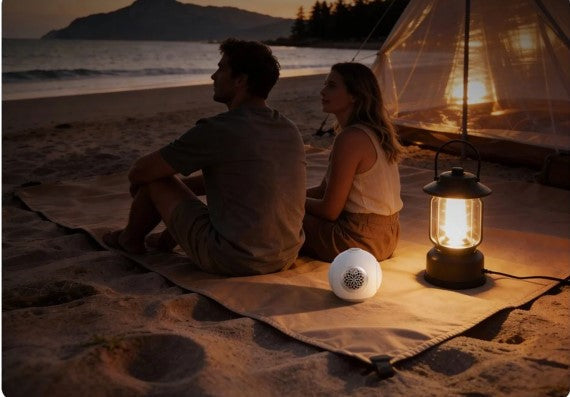
That can be useful when gaming from a desk, watching from a sofa, or moving around a room.
360° Sound Changes Where You Can Listen
Traditional front-firing speakers tend to have a preferred listening direction.
That can work well when a listener sits directly in front of the speaker. But a portable speaker is often used differently.
You may:
- Sit beside it
- Move around the room
- Watch a movie from an angle
- Use it while working
- Share the room with other people
The dB1's spherical architecture supports 360° spherical dispersion, creating a broader presentation rather than concentrating the sound toward one narrow direction.
This doesn't eliminate room acoustics or guarantee identical sound at every position. Walls, furniture, distance, and speaker placement still matter.
But the underlying dispersion approach makes the speaker more flexible for shared listening environments.
A Practical Comparison for Movies and Gaming
|
Feature |
Typical Portable Speaker |
UB+ dB1 DoubleBass |
|
Wireless connection |
Model dependent |
Bluetooth 5.3 |
|
Enclosure |
Often rectangular or conventional portable form |
Spherical acoustic chamber |
|
Bass approach |
Often combines DSP and conventional acoustic loading |
Mechanical air-pressure reinforcement |
|
Driver arrangement |
Model dependent |
Central downward-firing mid-bass driver |
|
Passive radiators |
Varies |
Dual symmetrical passive radiators |
|
Radiator surface area |
Varies |
Approximately 3.5× woofer area |
|
Mechanical behavior |
Depends on enclosure design |
Opposing radiator movement helps balance forces |
|
Dispersion |
Model dependent |
360° spherical presentation |
|
Movie use |
Depends on latency and acoustic tuning |
Designed around stable wireless and acoustic reproduction |
|
Gaming use |
Depends on complete signal chain |
Bluetooth 5.3 plus controlled acoustic architecture |
The comparison is important because no single specification determines the quality of a movie or gaming experience.
What to Look for When Buying a Bluetooth Speaker for Movies
If movies are your primary use, start with connection behavior and synchronization rather than simply looking for the largest bass specification.
Check:
Connection stability
A speaker that frequently disconnects is frustrating regardless of how good it sounds.
Latency behavior
For video, synchronization between image and sound matters. Look for documented low-latency support where available, and consider the source device as part of the equation.
Dialogue clarity
A speaker should preserve voices without requiring excessive volume.
Controlled bass
Low frequencies should add weight without masking dialogue or becoming boomy.
Dispersion
If multiple people will watch from different positions, broad sound distribution can be useful.
Physical design
The enclosure and driver architecture influence how faithfully the wireless signal becomes acoustic output.
What to Look for When Buying for Gaming
Gaming adds another set of considerations.
Think about:
How close will you sit?
A desk setup has different requirements from a living-room setup.
How important is timing?
Competitive gaming makes latency more noticeable than casual gaming.
Do you need wide coverage?
A spherical speaker can make sense when listeners aren't positioned directly in front.
How much bass do you actually need?
Impact is useful, but excessive bass can mask smaller details.
Will you use the speaker for other things?
A speaker used for gaming, music, movies, and work needs a balanced overall presentation.
Bluetooth 5.3 Is One Part of the Equation
The most useful takeaway is simple:
Bluetooth 5.3 does not replace acoustic engineering.
It can provide a modern wireless foundation, but the speaker still has to transform that digital information into physical sound.
That transformation depends on:
- Wireless communication
- Codec processing
- Amplification
- Driver movement
- Enclosure geometry
- Air pressure
- Resonance control
- Sound dispersion
The dB1 DoubleBass is designed around this complete-system approach.
Its Bluetooth 5.3 connectivity provides the wireless interface, while its spherical chamber, downward-firing driver, and symmetrical passive radiators form the physical foundation for its low-frequency reproduction.
When Wireless Convenience Meets Acoustic Design
The evolution of Bluetooth audio has made it possible to build compact speakers that are far more capable than early wireless systems.
But the technology inside the connection is only part of the story.
A movie doesn't become immersive because a speaker says "Bluetooth 5.3" on its specification sheet. A game doesn't become convincing because a codec has a technical name.
The final experience comes from what happens after the signal arrives.
That is where enclosure geometry, driver control, mechanical stability, and air movement become important.
The dB1 DoubleBass approaches this challenge through a spherical Helmholtz-inspired acoustic chamber, dual symmetrical passive radiators, and a centrally positioned driver designed to energize the internal air volume.
The philosophy is straightforward:
Don't force the bass. Engineer the system so the air can help produce it.
Final Thoughts
Bluetooth 5.3, codecs, and latency are important parts of modern wireless audio, especially when a speaker is used for movies and gaming.
But they should never be evaluated separately from the physical speaker.
A reliable wireless connection delivers the signal. The codec manages its transmission. The amplifier powers the system. The driver moves. The enclosure controls pressure. The passive radiators extend low-frequency output. And the overall acoustic architecture determines how that energy becomes sound.
The UB+ dB1 DOUBLEBASS brings these elements together through a spherical enclosure, Helmholtz-inspired acoustic design, symmetrical passive radiators, and controlled driver movement.
For listeners who want a compact wireless speaker that can move between music, movies, gaming, and everyday listening, that combination of wireless technology and physical acoustic engineering is what deserves attention.
Frequently Asked Questions
1. Does Bluetooth 5.3 automatically mean better sound quality?
No. Bluetooth 5.3 relates primarily to wireless communication capabilities. Overall sound quality also depends on the codec, source device, amplifier, driver, enclosure, DSP, and acoustic design.
2. Why does Bluetooth latency matter for movies?
Latency creates a delay between the video and the sound. If that delay becomes noticeable, dialogue can appear out of sync with lip movement and sound effects can feel disconnected from on-screen action.
3. Are codecs more important than the speaker itself?
Codecs are important because they determine how audio data is encoded and transmitted, but they cannot compensate for poor physical acoustic reproduction. The codec and speaker architecture should be considered together.
4. Why does the dB1 use a spherical enclosure?
The dB1 uses a spherical acoustic chamber to create a different internal pressure environment from conventional rectangular cabinets. The design is intended to reduce problematic standing-wave behavior and support controlled resonance and harmonic reproduction.
5. What makes the dB1 DoubleBass different for bass reproduction?
Its acoustic system combines a centrally positioned mid-bass driver, spherical chamber, and two opposing passive radiators. The combined passive-radiator surface area is approximately 3.5 times the woofer's surface area, providing substantial moving area for low-frequency air displacement.
Explore More UB+ Audio Guides
If you want to go deeper into the technology behind the dB1, these existing UB+ articles are useful next steps:
- How Passive Radiators Work in Bluetooth Speakers
- Bass Extension Explained: Hz and Speaker Frequency Response
- 360° vs Front-Firing Speakers
- Speaker Distortion Explained
- Bluetooth Speaker Placement Tips for Bass & Clarity
- Spherical vs. Box Speakers: Sound Comparison
These links are intentionally distributed around related topics rather than grouped into one section, so they support the article naturally without creating an internal-link block.
Ready to Experience the Difference?
→ Compare dB1 vs dB Mini
→ See color options
→ Check current price
Understanding the technology is the first step. The real difference comes from how wireless technology, mechanical design, and acoustic engineering work together.


댓글 남기기
이 사이트는 hCaptcha에 의해 보호되며, hCaptcha의 개인 정보 보호 정책 과 서비스 약관 이 적용됩니다.