
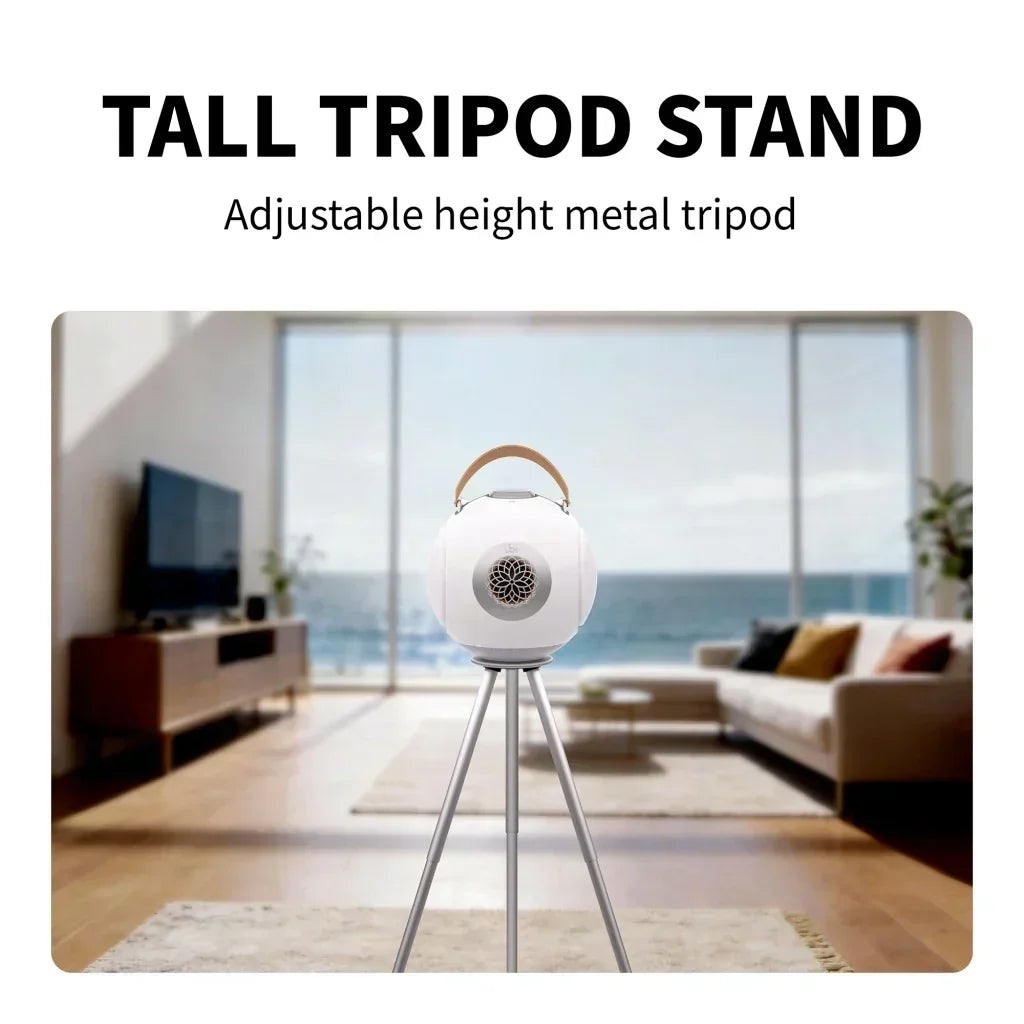
A tripod bluetooth speaker can deliver a very different listening experience depending on how high it is positioned. Raising a speaker off the floor changes its relationship with nearby surfaces, listeners, and the surrounding air. While elevation can improve sound coverage and reduce unwanted reflections, it does not automatically create deeper bass. Low-frequency performance depends on enclosure design, driver movement, acoustic loading, and how the speaker interacts with the environment.
For buyers comparing portable speakers, party systems, and spherical designs, speaker height is an important consideration. A well-positioned speaker can sound clearer, project music more evenly, and reduce the need to increase volume. However, the best height depends on the speaker’s bass response, cabinet design, listening distance, and whether the system is used indoors or outdoors.
This guide explains how tripod placement affects bass projection, when elevated positioning is useful, and what to consider before choosing a portable speaker with a tripod or another elevated Bluetooth audio system.
What Is a Tripod-Mounted Bluetooth Speaker?

A tripod-mounted Bluetooth speaker is a wireless speaker placed on a three-legged stand that raises the enclosure above the floor or ground. The speaker may be designed specifically for tripod use, or it may connect to a compatible stand through a mounting socket.
Unlike a conventional speaker placed on a table, shelf, or floor, an elevated speaker has fewer immediate obstacles around its enclosure. This can improve the direct path between the driver and listeners, particularly when people are standing or when the speaker is used in a larger room.
Common applications include:
- Outdoor gatherings
- Small parties and events
- Presentations
- Mobile DJs
- Backyard listening
- Fitness classes
- Community spaces
- Indoor rooms where floor space is limited
A tripod does not change the internal acoustic design of a speaker. It changes the speaker’s placement geometry, which can influence how sound travels through the room or outdoor environment.
This distinction matters. A tripod can improve coverage and clarity, but it cannot compensate for a weak driver, poorly designed enclosure, limited amplifier power, or insufficient low-frequency extension.
Why Speaker Height Matters

Speaker placement height affects three main factors:
- Direct sound coverage
- Interaction with nearby surfaces
- Perceived bass and tonal balance
High frequencies are more directional than low frequencies. Treble and upper midrange can be blocked by furniture, seated listeners, or other objects. Raising the speaker places the acoustic output closer to ear level, helping more listeners receive direct sound.
Bass behaves differently. Low frequencies have long wavelengths and spread more widely around the speaker. They are also strongly influenced by boundaries such as floors, walls, corners, and ceilings.
For this reason, raising a speaker may improve vocal clarity while slightly changing the perceived weight of the bass. Whether the bass sounds stronger or weaker depends on the room, the speaker’s enclosure, and the distance from surrounding surfaces.
Does Raising a Speaker Improve Bass Projection?
The short answer is: sometimes, but not always.
Bass projection is not simply a matter of placing a speaker higher. Low-frequency output depends on several interacting factors:
- Driver size
- Driver excursion
- Enclosure volume
- Passive radiator or port design
- Internal air pressure
- Amplifier power
- DSP limiting
- Distance from walls and floors
- Listening position
- Outdoor versus indoor use
When a speaker sits directly on the floor, the floor can reinforce certain low frequencies. This is sometimes called boundary reinforcement. A speaker near a wall or in a corner may produce even more bass because the nearby surfaces influence the way low-frequency energy spreads.
However, boundary reinforcement is not always balanced. It can create uneven bass, excessive resonance, or a boomy sound in certain parts of the room.
Raising a speaker on a tripod reduces its immediate contact with the floor and can create a more consistent listening position. The result may be tighter or cleaner bass, but the speaker may also lose some of the additional low-frequency reinforcement created by the floor.
Therefore, a tripod should be viewed primarily as a tool for sound coverage and placement control, not as a bass-enhancement device.
Floor Placement Versus Tripod Placement
The difference between floor placement and tripod placement becomes easier to understand when the two setups are compared directly.
|
Factor |
Floor Placement |
Tripod Placement |
|
Listening height |
Often below ear level |
Can be positioned near ear level |
|
Treble coverage |
May be blocked by people or furniture |
Usually more direct to listeners |
|
Bass reinforcement |
May receive stronger floor interaction |
Less direct floor reinforcement |
|
Sound distribution |
Can be uneven in crowded spaces |
Often improves coverage across standing listeners |
|
Portability |
Easy to place but may occupy floor space |
Requires stand and setup area |
|
Stability |
Usually stable on a flat surface |
Depends on tripod quality and setup |
|
Best use |
Close listening, desktop or floor-level use |
Events, gatherings, outdoor and elevated listening |
A speaker on the floor may sound bass-heavy in one location and thin in another. A tripod-mounted speaker may sound more balanced across a wider area because it is positioned above obstacles and away from some boundary effects.
The better choice depends on whether the priority is maximum bass reinforcement, wider coverage, or more consistent sound throughout the listening area.
How Speaker Height Changes Perceived Bass
Human hearing does not evaluate bass independently from the rest of the frequency range. When a speaker’s midrange and treble become clearer, the overall sound may appear more balanced even if the actual low-frequency output has not increased.
This is one reason elevated placement can change the perception of bass.
1. Clearer Midrange Can Make Bass Sound More Controlled
When a speaker is placed behind furniture or below the listener’s ear level, vocals and instruments may become less distinct. Raising the speaker can improve direct midrange output.
The bass may then seem less dominant because the rest of the frequency spectrum becomes easier to hear. This does not necessarily mean the speaker produces less bass. It may simply mean the tonal balance is more controlled.
2. Reduced Floor Coupling Can Change Low-Frequency Weight
A speaker placed directly on the floor interacts with that surface. Depending on the enclosure and frequency range, this can increase perceived low-frequency energy.
Moving the speaker onto a tripod reduces this direct floor interaction. Some setups may sound cleaner, while others may sound lighter.
3. Distance From Walls Can Reduce Boominess
A tripod makes it easier to move the speaker away from walls and corners. This is important because low frequencies can accumulate near boundaries.
A speaker placed too close to a corner may produce excessive energy at certain frequencies. Moving it away from the corner can improve bass clarity, even if the sound initially seems less powerful.
4. Listening Distance Affects Bass Perception
The distance between the speaker and the listener also matters. A speaker positioned high on a tripod may project sound across a larger area, but listeners farther away may perceive less bass than someone standing close to the enclosure.
This is especially relevant outdoors, where there are fewer walls and ceilings to reflect low-frequency energy.
Tripod Height and Ear-Level Listening
For many gatherings, the most practical tripod height is one that places the speaker’s main acoustic output near or slightly above the ear level of the audience.
The ideal height depends on the speaker’s design. A front-firing speaker may benefit significantly from being raised because its high-frequency output is directed toward listeners. A spherical or wide-dispersion speaker may be less dependent on exact orientation.
When people are standing, a speaker positioned too low may direct sound into the backs of people in front of it. Raising the speaker can help the sound travel over the nearest listeners and reach more people.
For seated listening, the speaker may not need to be as high. A lower position can sometimes provide a better balance between direct sound and room interaction.
The goal is not to place every speaker as high as possible. The goal is to achieve consistent coverage without making the speaker unstable or unnecessarily distant from the audience.
Spherical Speakers and Tripod Placement
Spherical speakers require a different approach from conventional rectangular or front-firing cabinets.
A traditional speaker often has a clear front. Its position and angle determine where much of the high-frequency sound travels. A spherical speaker, by contrast, can distribute sound more evenly around its enclosure.
This makes spherical designs useful for social environments where listeners are not sitting in one fixed direction.
A 360-degree Bluetooth speaker can reduce the need for constant repositioning because sound is not limited to a single front-facing listening zone. However, not every spherical speaker produces identical coverage. The internal driver arrangement, acoustic chamber, passive radiators, and frequency response still determine performance.
For a deeper explanation of directional and omnidirectional designs, see 360-degree versus front-firing speakers.
Why Spherical Enclosure Design Matters
A spherical enclosure can distribute internal air pressure more evenly than many conventional box-shaped cabinets. This can help reduce certain internal reflections and standing-wave behavior.
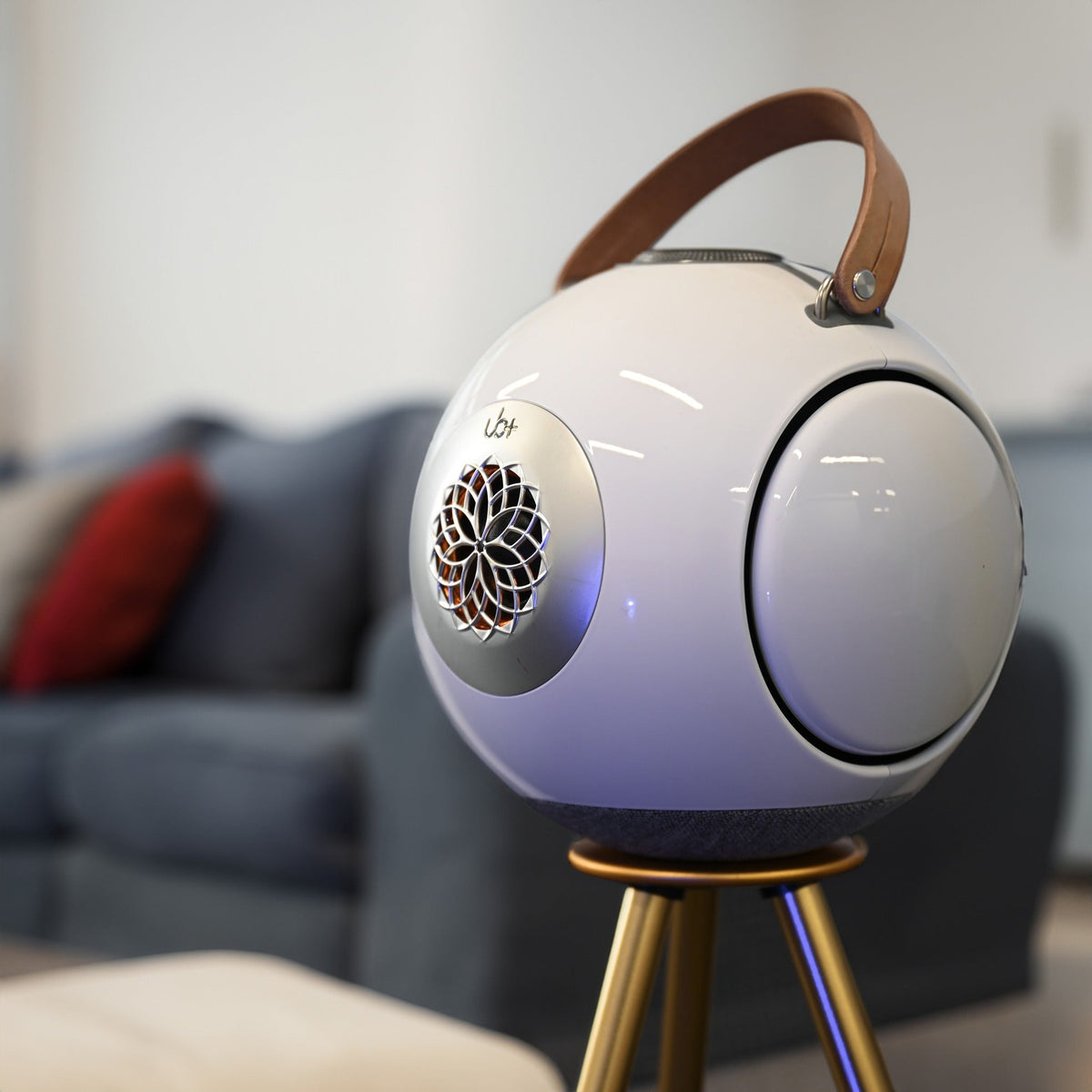
In the UB+ dB1 DoubleBass design, the spherical acoustic chamber is inspired by the Helmholtz resonance principle. The enclosure is designed to let the internal air volume contribute to the acoustic system rather than relying only on a conventional rectangular cabinet.
The dB1 also uses a central mid-bass driver and two opposing passive radiator plates. The passive radiators provide additional acoustic surface area while their symmetrical arrangement helps reduce unwanted cabinet movement.
This is important when considering tripod placement. A speaker that produces bass through a controlled acoustic structure may behave differently from a small box speaker that depends heavily on a port, passive radiator, or DSP-generated bass boost.
The tripod changes the speaker’s relationship with the environment. The spherical enclosure determines how the speaker generates and distributes sound in the first place.
Acoustic Spotlight: How the UB+ dB1 DoubleBass Produces Bass
The UB+ dB1 DoubleBass is designed around a spherical acoustic chamber rather than a conventional rectangular box.
Its bass system combines:
- A 4.5-inch long-throw mid-bass driver
- A spherical acoustic chamber
- Two opposing passive radiator plates
- A large combined passive-radiator surface area
- A powerful neodymium magnet structure
- DSP for monitoring, protection, and tonal control
The driver works into the spherical chamber, while the passive radiators respond to changes in internal air pressure. Their opposing placement helps create a more balanced mechanical structure and reduces unwanted enclosure vibration.
This approach differs from simply boosting low frequencies electronically. DSP can help optimize output and protect the driver, but the physical acoustic system remains responsible for much of the bass behavior.
For a closer explanation of this architecture, read how spherical speaker design supports bass performance.
The key consideration for tripod use is that elevation does not replace acoustic engineering. A well-designed speaker can retain controlled bass at different heights, but the surrounding environment will still affect the final result.
Passive Radiators, Ports, and Elevated Placement
Many portable Bluetooth speakers use either a tuned port or one or more passive radiators to extend low-frequency response.
A port uses an opening and an air column to reinforce a specific range of frequencies. A passive radiator uses a moving diaphragm instead of an open port. Both systems can improve bass extension when properly designed.
Their performance may change depending on placement.
For example, a port located near the bottom or rear of a speaker may interact with the floor or wall. Blocking the port can reduce output or create unwanted noise. A passive radiator may also require adequate clearance to move freely.
Before mounting a speaker on a tripod, check:
- Whether the speaker has a bottom-facing port
- Whether passive radiators are located near the stand
- Whether the mounting plate blocks airflow
- Whether the speaker requires a specific orientation
- Whether the stand creates vibration or rattling
- Whether the speaker is approved for tripod mounting
The difference between passive radiators and ports is explained in Passive Radiators vs. Ported Boxes.
Indoor Tripod Placement
Indoor rooms create more acoustic interactions than open outdoor spaces. Walls, floors, ceilings, furniture, and room dimensions all influence the final sound.
A tripod can be useful indoors when:
- The room contains many people
- Furniture blocks the speaker
- The speaker needs to cover a larger seating area
- Floor space is limited
- The speaker must be positioned away from corners
- Clearer speech and vocals are important
However, a tripod is not always the best solution for a small room. If the speaker is placed too high or too far away, listeners may receive less direct bass and the system may need to operate at a higher volume.
For smaller spaces, test the speaker at several heights. Compare the sound from the intended listening position rather than judging it only beside the speaker.
Room acoustics also affect how much bass is heard in different locations. A useful starting point is this guide to why the same speaker can sound different in different rooms.
Outdoor Tripod Placement
Outdoor listening changes the placement equation because there are fewer surfaces to reinforce sound.
In an open area, bass energy spreads outward without the same degree of wall and floor reinforcement found indoors. This can make low frequencies seem less powerful, particularly at a distance.
A tripod can still be valuable outdoors because it raises the speaker above grass, furniture, and nearby listeners. It can also improve the distribution of vocals, instruments, and high-frequency detail.
For outdoor use, consider:
- Speaker height relative to the audience
- Wind and weather conditions
- Ground stability
- Distance from the listening area
- Battery capacity
- Maximum clean output
- Water and splash resistance
- Stand weight and portability
A speaker with an IPX5 rating, for example, can resist water jets and splashes under specified test conditions, but it should not be treated as fully waterproof or suitable for submersion.
The best outdoor Bluetooth speaker setup balances coverage, stability, battery performance, and acoustic output rather than focusing only on maximum volume.
How High Should a Tripod Bluetooth Speaker Be?
There is no universal height that works for every speaker. The correct position depends on the speaker’s dispersion pattern, audience size, and listening arrangement.
As a practical starting point:
- For seated listeners, position the speaker around seated ear level or slightly above.
- For standing gatherings, raise the speaker so its main output clears the nearest listeners.
- For small indoor rooms, avoid placing the speaker unnecessarily high or far away.
- For outdoor use, prioritize stable coverage and a clear path to the audience.
- Keep the speaker away from corners when excessive bass buildup is a problem.
- Ensure the tripod is fully opened and securely locked.
A tripod should never be extended so high that it becomes unstable in wind, on uneven ground, or when people are moving around it.
The speaker’s mounting socket and the tripod’s load rating must also be compatible. A lightweight photographic tripod may not be suitable for a heavier audio enclosure.
Does a Tripod Make a Speaker Louder?
A tripod does not increase the amplifier’s power or the speaker’s maximum acoustic output. It may, however, make the speaker seem louder or clearer across a larger area.
This happens because elevation can:
- Improve line-of-sight coverage
- Reduce obstruction from people and furniture
- Direct more midrange and treble toward listeners
- Reduce certain floor-level reflections
- Improve consistency between listening positions
The distinction between loudness and coverage is important. A speaker that sounds clear throughout a gathering may be more useful than one that produces a higher peak volume but becomes muddy or uneven at the edges of the listening area.
When comparing speakers, review their maximum clean SPL, frequency response, driver design, and dispersion pattern. Wattage alone does not determine how loud or effective a speaker will sound.
For more information, see How Loud Should a Speaker Be? Understanding SPL.
What to Look for When Buying a Tripod-Mounted Bluetooth Speaker
If tripod compatibility is important, evaluate the entire system rather than choosing a speaker based only on its mounting socket.
1. Mounting Compatibility
Check whether the speaker includes a standard mounting connection and whether the tripod is rated for its weight. The connection should be secure and designed for repeated setup and removal.
2. Dispersion Pattern
A front-firing speaker may require careful aiming. A spherical or wide-dispersion design may provide more flexible placement for gatherings where listeners surround the speaker.
3. Bass Architecture
Look beyond marketing terms such as “extra bass.” Examine whether the speaker uses a port, passive radiator, sealed enclosure, or a more complex acoustic chamber.
The physical design affects bass extension, distortion, cabinet vibration, and performance at higher volume.
4. Clean Output
Maximum volume is useful only if the speaker remains controlled. Excessive DSP limiting, distortion, or compression can make a speaker sound harsh or weak when pushed.
5. Battery Performance
A tripod-mounted speaker is often used away from power outlets. Consider realistic playback duration at the volume level required for the event.
6. Weather Resistance
For outdoor use, look for a clearly stated IP rating. Understand whether the rating covers splashes, water jets, dust, or submersion.
7. Portability
The speaker, tripod, cables, and accessories should be easy to transport. A complicated setup may be unsuitable for casual gatherings.
8. Placement Flexibility
A good speaker should perform acceptably on a table, shelf, floor, or stand when used according to the manufacturer’s guidance. Placement flexibility increases its usefulness across different environments.
Tripod Speakers Versus Spherical Portable Speakers
Tripod-mounted systems and spherical portable speakers are not necessarily competing categories. They solve different placement problems.
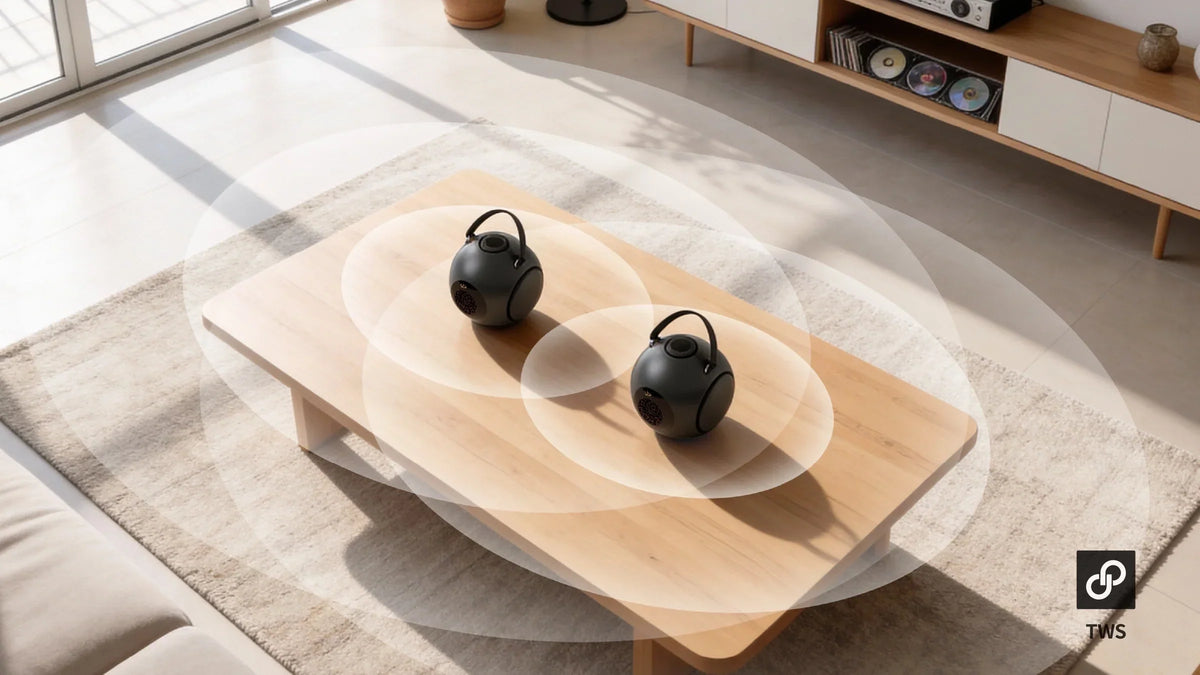
A tripod system is useful when the speaker must be elevated above listeners or furniture. A spherical portable speaker is useful when sound needs to reach people positioned around the enclosure.
The comparison depends on the environment.
|
Consideration |
Tripod-Mounted Speaker |
Spherical Portable Speaker |
|
Main advantage |
Elevated coverage |
Broad sound distribution |
|
Best for |
Standing audiences and events |
Social listening and flexible placement |
|
Bass behavior |
Influenced by height and boundary distance |
Influenced by enclosure and surrounding surfaces |
|
Setup |
Requires stand |
Usually faster to position |
|
Portability |
Includes separate tripod |
Often simpler to carry |
|
Directionality |
Depends on speaker design |
Often designed for wider dispersion |
|
Placement control |
High |
High, but without elevation unless supported |
|
Ideal buyer |
Needs coverage over people or furniture |
Wants flexible listening around the speaker |
A spherical speaker can also be placed on a suitable stand if the design supports it. In that case, the buyer receives both broad dispersion and elevated placement.
Common Tripod Placement Mistakes
Placing the Speaker Too Close to a Wall
A wall may reinforce certain bass frequencies and create an uneven response. If the sound is boomy, move the speaker farther away and compare again.
Blocking the Passive Radiators or Ports
A stand, mounting plate, or nearby object can interfere with the speaker’s acoustic openings. Always maintain the clearance recommended by the manufacturer.
Extending the Tripod Too Far
A high speaker is not useful if it is unstable. Use the lowest height that provides adequate coverage.
Ignoring the Listening Area
Do not judge the setup only from directly beside the speaker. Walk around the room or gathering area and listen for changes in bass, vocals, and overall balance.
Assuming More Height Means More Bass
Elevation improves access to the audience, but it does not automatically increase low-frequency output. Bass depends primarily on the speaker’s acoustic system and its interaction with the environment.
Increasing Volume to Compensate for Poor Placement
If a speaker sounds weak or uneven, reposition it before increasing volume. Excessive volume can introduce distortion, compression, or battery drain without solving the underlying placement issue.
Final Buying Considerations
A tripod bluetooth speaker is worth considering when sound coverage, elevation, and flexible positioning are important. Raising the speaker can improve direct sound, reduce obstructions, and help distribute music across a standing audience. It can also change the perceived bass by reducing floor interaction or moving the speaker away from walls and corners.
However, tripod placement is only one part of the system. The speaker’s enclosure, driver, passive radiator arrangement, DSP behavior, dispersion pattern, and maximum clean output remain more important to its fundamental performance.
For buyers interested in spherical audio, the UB+ dB1 DoubleBass offers a different approach. Its spherical acoustic chamber, central driver, and symmetrical passive radiator system are designed to control internal air movement and reduce unwanted cabinet vibration. That acoustic architecture determines how the speaker produces bass; placement then determines how that bass interacts with the room or outdoor environment.
The best setup is not necessarily the highest one. It is the position that provides stable placement, clear coverage, controlled bass, and consistent sound for the people listening.
Frequently Asked Questions
1. Does a tripod make a Bluetooth speaker produce deeper bass?
No. A tripod does not create deeper bass by itself. It changes the speaker’s height and relationship with nearby surfaces. Deeper bass depends on the driver, enclosure, passive radiator or port design, amplifier, and acoustic tuning.
2. Is a tripod-mounted speaker better for outdoor gatherings?
It can be. Elevating the speaker may improve sound coverage by placing the output above people and obstacles. However, outdoor bass performance still depends on the speaker’s acoustic design, output capability, and distance from the audience.
3. Should a spherical speaker be placed on a tripod?
If the speaker and stand are compatible, elevated placement may improve coverage in a standing crowd. A spherical design already provides broad sound distribution, so the tripod’s main benefit is elevation rather than creating a wider dispersion pattern.
4. Can raising a speaker reduce bass?
Yes. Raising a speaker can reduce the floor reinforcement that sometimes increases perceived bass. The result may sound lighter but more controlled. The effect depends on the room, speaker design, and distance from walls and floors.
5. What is more important: tripod height or speaker design?
Speaker design is more important to fundamental sound quality. Tripod height helps optimize coverage and placement, but it cannot compensate for limited bass extension, high distortion, weak amplification, or poor enclosure engineering.
Explore UB+ Options
→ Explore the UB+ dB1 DoubleBass


Hinterlasse einen Kommentar
เว็บไซต์นี้ได้รับการคุ้มครองโดย hCaptcha และมีการนำนโยบายความเป็นส่วนตัวของ hCaptcha และข้อกำหนดในการใช้บริการมาใช้