

When people search for a new Bluetooth speaker, specifications are usually the first thing they see. Battery capacity, driver size, frequency response, connectivity, and maximum volume can help narrow down a purchase, but specifications do not fully explain how a speaker feels to use every day.
That is where reviews and real-world listening impressions become valuable. A reviewer can evaluate how a speaker behaves in a room, whether its bass remains controlled at higher volumes, how its design works in practice, and whether the product feels as refined as its specifications suggest.
The UB+ dB1 DoubleBass and dB Mini take a particularly different approach to portable audio. Instead of following the conventional rectangular-speaker formula, the range places considerable emphasis on spherical acoustic design, mechanical bass reproduction, and visual integration with modern spaces.
This makes the UB+ lineup interesting not simply because of how it looks, but because of the engineering decisions behind that appearance.
Why Reviewer Opinions Matter

Audio specifications provide measurable information, but they do not tell the entire listening story.
Two speakers can advertise similar frequency ranges and still sound very different because of their enclosure design, driver implementation, acoustic tuning, dispersion pattern, and interaction with the room.
This is why experienced reviewers generally look beyond individual specifications. They listen for characteristics such as:
- Bass depth and control
- Vocal and midrange clarity
- Performance at different volume levels
- Sound dispersion
- Build quality
- Industrial design
- Ease of placement
- Long-session listening behavior
For someone looking for a best portable Bluetooth speaker, these practical observations can be more useful than comparing specification sheets alone.
UB+ has also explored the broader factors that influence premium audio in its guide to the science behind premium audio technology.
The Design Philosophy Behind UB+

The first thing that separates UB+ from many conventional portable speaker designs is its approach to the enclosure.
The UB+ dB1 DoubleBass uses a true spherical acoustic chamber rather than a conventional rectangular cabinet. The design is inspired by the principles of Helmholtz resonance, using the behavior of air inside a controlled chamber as part of the acoustic system.
The sphere is therefore more than an aesthetic decision.
Its geometry is integrated into the way the speaker manages internal air pressure and acoustic behavior. The dB1 combines that chamber with a long-throw mid-bass driver and two opposing passive radiators to create its low-frequency system.
This is an important distinction when considering reviewer impressions. A speaker can look unusual simply for visual differentiation, but in the dB1 the unusual shape is directly connected to the acoustic architecture.
What Makes the dB1 DoubleBass Different

The dB1's most distinctive feature is the relationship between its spherical chamber, active driver, and passive radiators.
A 4.5-inch long-throw mid-bass driver works inside the spherical acoustic chamber. Two large passive radiator plates are positioned on opposite sides of the enclosure.
As the driver moves, it creates changes in internal air pressure. That pressure drives the passive radiators, adding acoustic output without requiring the active driver to produce all of the low-frequency movement by itself.
The combined surface area of the two passive radiators is approximately 3.5 times the area of the active woofer.
That is an important engineering detail because bass reproduction depends heavily on air displacement. Giving the acoustic system more radiating area allows it to move substantial amounts of air while maintaining controlled driver movement.
The opposing radiator arrangement also helps manage mechanical reaction from the bass system, reducing unwanted cabinet movement.
This is the foundation behind the dB1's DoubleBass concept.
Why the Spherical Enclosure Gets Attention

A spherical speaker naturally attracts attention because it looks different from the rectangular boxes that dominate the portable audio market.
But the more interesting question is whether the shape has an acoustic purpose.
In the dB1, it does.
A conventional rectangular enclosure contains parallel surfaces that can contribute to internal reflections and standing-wave behavior. A spherical chamber removes that parallel-wall geometry and creates a continuous curved internal environment.
The goal is not to claim that a sphere eliminates every acoustic problem. Rather, the geometry is designed to provide more controlled internal pressure behavior and support cleaner reproduction.
This is one reason the dB1's appearance and acoustic engineering cannot really be separated. The sphere is simultaneously part of the product's visual identity and its sound-producing architecture.
For a closer look at this concept, see UB+’s article on spherical speakers and modern audio design.
What the Bass Architecture Means in Practice

Reviewers and listeners often pay close attention to bass because it is one of the easiest areas to exaggerate in a compact speaker.
A speaker can sound impressive for a few seconds simply by emphasizing the low frequencies. But excessive bass can eventually make music feel congested, particularly when vocals, guitars, keyboards, and other midrange information become masked.
The dB1 takes a different approach.
Its bass performance is based primarily on the physical interaction between the driver, spherical chamber, and passive radiators. DSP can support the system through protection, linearity, and tonal optimization, but the physical acoustic design remains central.
That distinction matters because deep bass and boosted bass are not the same thing.
Deep bass means the speaker can reproduce lower frequencies with meaningful output. Boosted bass simply means the speaker has emphasized a portion of the frequency range.
A well-engineered system aims for both depth and control.
Driver Engineering Behind the dB1

The acoustic enclosure is only part of the equation. The active driver also needs to handle the mechanical demands of low-frequency reproduction.
The dB1 uses a 4.5-inch long-throw mid-bass driver with a 90mm neodymium magnet, 35mm long-stroke voice coil, and approximately 20mm piston movement. An aluminum shorting ring is also part of the driver architecture.
These components are intended to support controlled driver movement and stable operation.
The significance is not that one specification automatically makes a speaker better. Instead, the driver has been designed as part of the larger acoustic system.
The spherical chamber, passive radiators, driver excursion, and mechanical structure have to work together. Looking at any one component in isolation gives an incomplete picture of why the speaker sounds the way it does.
Why Long-Session Listening Matters

A speaker that sounds impressive for a short demonstration is not necessarily a speaker that remains enjoyable for several hours.
Aggressive bass tuning can initially create a strong impression. Over time, however, excessive low-frequency emphasis can make music sound less balanced and reduce the clarity of vocals and instruments.
For everyday use, balance becomes more important.
A speaker used while working, relaxing, watching movies, or listening to music throughout the day needs to remain coherent across its frequency range rather than constantly drawing attention to one part of the spectrum.
This is one reason real-world listening impressions are useful. They reveal how a speaker behaves outside a short demonstration.
UB+ also explores listening environments in its guide to speaker setups for relaxing evenings.
The dB Mini: A Smaller Expression of the Same Design Direction
The UB+ dB Mini takes the same broader design philosophy into a smaller format.
Its compact size makes it easier to integrate into desks, bedrooms, shelves, and smaller listening spaces. The spherical design also gives it a distinctive visual character compared with conventional rectangular portable speakers.
The dB Mini should not be expected to reproduce the same low-frequency scale as the larger dB1. Physical size places real limits on air displacement and acoustic output.
What makes the Mini interesting is how much of the UB+ design identity remains intact in a smaller product.
For listeners who prioritize compactness and flexibility, it provides a different entry point into the UB+ range.
The differences between the two models are explored in more detail in UB+’s dB1 vs dB Mini comparison.
Design Is Part of the Listening Experience
Modern speakers increasingly occupy visible spaces.
A speaker may sit on a living-room table, desk, bedroom shelf, or studio workspace for years. That makes industrial design more important than it was when audio equipment was commonly hidden inside cabinets or dedicated media furniture.
The spherical form of UB+ speakers gives them a different relationship with their surroundings.
Instead of looking like conventional electronics, the rounded enclosure can function as part of an interior. Its visual simplicity also avoids the heavy rectangular appearance associated with many traditional speaker cabinets.
That design philosophy connects directly with the broader movement toward designer speakers, where acoustic performance and visual integration are considered together.
UB+ discusses this relationship in its guide to the benefits of designer speakers.
How the dB1 Fits Into Different Listening Environments
One advantage of a broad-dispersion spherical design is placement flexibility.
A conventional front-firing speaker generally has a preferred listening direction. The further a listener moves away from that axis, the more the perceived sound can change.
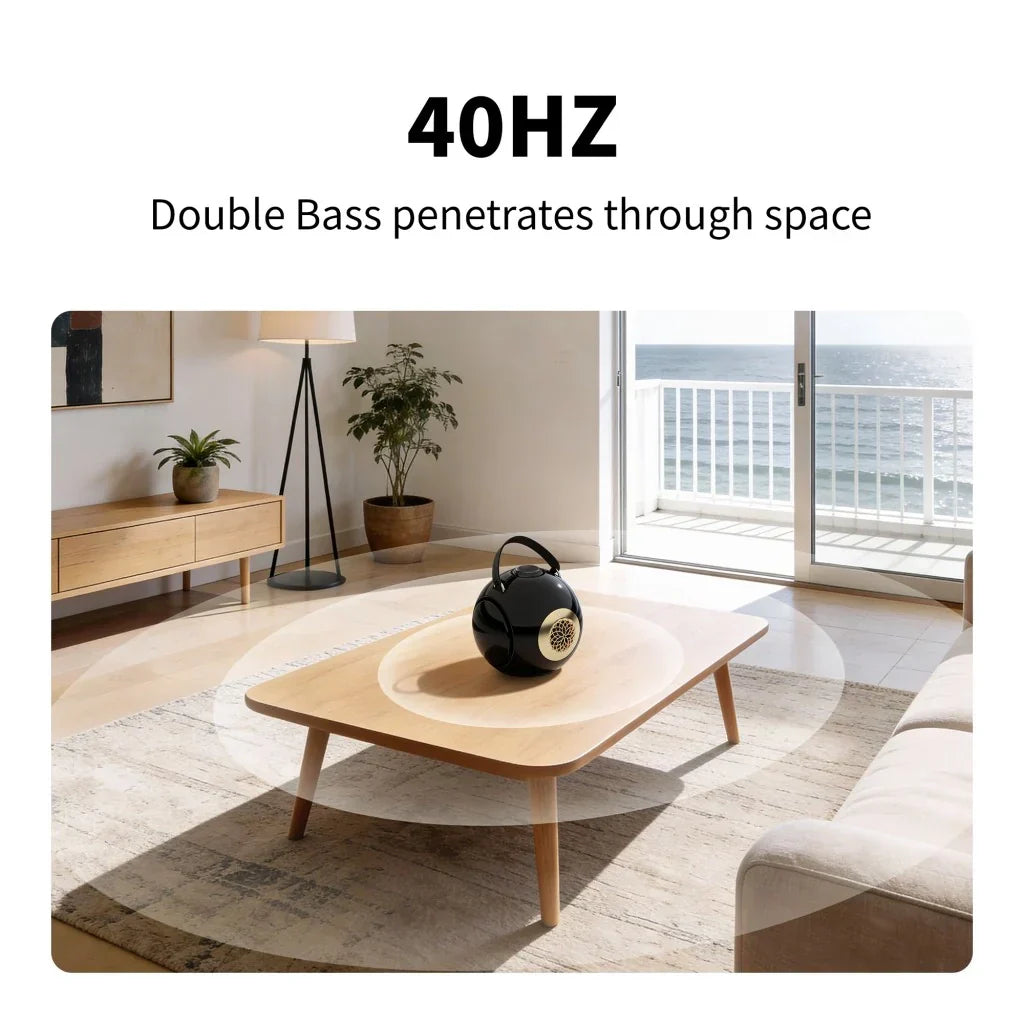
The dB1's spherical architecture is designed around broad 360° sound dispersion, making it well suited to environments where people are not always sitting directly in front of the speaker.
That can be useful in living rooms, open spaces, offices, and social settings.
Placement still matters. Walls, corners, floors, and furniture influence bass and reflections regardless of enclosure shape. But the speaker does not depend on one narrow listening axis in the same way as a strongly directional design.
For more on this subject, see UB+’s guide to 360° versus front-firing speakers.
What Reviewers and Buyers Should Look Beyond
When evaluating a speaker, the most useful review is not necessarily the one with the most enthusiastic language. It is the one that explains how the product behaves.
For UB+ speakers, several areas deserve particular attention.
Acoustic design: Does the reviewer explain how the spherical enclosure contributes to the system?
Bass behavior: Is the bass described as deep and controlled rather than simply loud?
Midrange clarity: Do vocals and instruments remain distinct when bass output increases?
Dispersion: How does the speaker sound when listeners move around it?
Build and design: Does the physical product feel consistent with its premium positioning?
Everyday use: How well does the speaker fit into a real home or workspace?
These observations provide more useful buying information than simply repeating a list of specifications.
UB+ Compared With Conventional Portable Speaker Design
It is tempting to reduce the market to a simple question of which brand is better. That is usually too simplistic.
Different manufacturers prioritize different things. Some focus heavily on ruggedness and outdoor portability. Others prioritize maximum output, compact dimensions, battery performance, or mainstream accessibility.
UB+ takes a particularly strong position around acoustic architecture and industrial design.
|
Feature |
Conventional Portable Speaker Design |
UB+ dB1 DoubleBass |
|
Enclosure geometry |
Typically rectangular |
Spherical acoustic chamber |
|
Bass architecture |
Varies by driver, port, or radiator |
Driver with dual opposing passive radiators |
|
Acoustic principle |
Depends on enclosure design |
Helmholtz-inspired chamber |
|
Passive-radiator area |
Varies |
Approximately 3.5× active woofer area |
|
Mechanical approach |
Depends on design |
Opposing radiator arrangement |
|
Sound dispersion |
Depends on enclosure |
Broad 360° dispersion |
|
Driver architecture |
Varies by model |
4.5-inch long-throw mid-bass driver |
|
Design priority |
Portability, output, durability, or other goals |
Acoustic engineering and industrial design |
The purpose of this comparison is not to suggest that every conventional portable speaker performs the same way. They do not. It highlights the different design philosophy behind the dB1.
Why Real-World Context Matters More Than a Specification List
Specifications are useful when they are interpreted in context.
A frequency-response figure tells you something about the speaker's operating range, but it does not explain how smoothly that range is reproduced.
A driver-size figure tells you the approximate diameter of the driver, but not how far it can move or how the enclosure loads it.
A maximum SPL figure indicates potential output, but not whether the speaker remains balanced at that level.
This is why the strongest reviews combine specifications with actual listening observations.
For buyers comparing portable speakers, UB+ recommends looking beyond isolated numbers and considering the complete acoustic system. Its Bluetooth speaker buying guide provides a broader framework for making that comparison.
Frequently Asked Questions
What do reviewers notice first about the UB+ dB1?
The spherical enclosure is usually the most immediately distinctive feature. Its importance goes beyond appearance because the sphere forms the basis of the dB1's acoustic chamber and contributes to its internal pressure management.
Is the dB1's bass mainly created through DSP?
No. The dB1's low-frequency architecture is primarily mechanical and acoustic. The spherical chamber, long-throw driver, and dual passive radiators perform the fundamental bass work, while DSP can support protection, linearity, and tonal optimization.
Is the dB Mini as powerful as the dB1?
No. The dB Mini is a smaller speaker and should not be expected to match the dB1's physical bass capability. Its advantage is its compact size and flexibility while retaining the UB+ spherical design direction.
What makes the dB1 different from a conventional box speaker?
Its spherical acoustic chamber and dual opposing passive radiators create a different approach to internal air pressure and low-frequency reproduction. The enclosure is part of the acoustic system rather than simply a rectangular housing for the electronics.
Should I rely only on reviews when choosing a speaker?
No. Reviews are most useful when combined with specifications, your room size, listening habits, placement requirements, and budget. A speaker that performs well for one reviewer may not be the best choice for every environment.
Final Thoughts
What makes the UB+ dB1 DoubleBass and dB Mini interesting is not simply that they look different.
The more important distinction is that their visual design is closely connected to their acoustic architecture. The dB1 uses a spherical chamber inspired by Helmholtz resonance, a long-throw mid-bass driver, and two opposing passive radiators to approach bass reproduction as a mechanical and acoustic problem.
The dB Mini brings the same design philosophy into a smaller format for listeners who prioritize compactness.
For anyone evaluating portable Bluetooth speakers, reviewer opinions are most useful when they go beyond phrases such as "powerful bass" or "premium design." The real questions are how the speaker creates that bass, how controlled it remains, how broadly it disperses sound, and how naturally it fits into everyday listening.
That is where the UB+ approach becomes distinctive: the product is designed around the relationship between air, enclosure geometry, mechanical movement, and sound, rather than treating the speaker as simply an electronic box.
Explore UB+ Options
→ Explore the UB+ dB1 DoubleBass
→ Compare the dB1 DoubleBass with the dB Mini
→ Explore UB+ Speakers
→ Check Current Price
Because the most useful review is not simply the one that says a speaker sounds good. It is the one that explains why it sounds the way it does.



Leave a comment
เว็บไซต์นี้ได้รับการคุ้มครองโดย hCaptcha และมีการนำนโยบายความเป็นส่วนตัวของ hCaptcha และข้อกำหนดในการใช้บริการมาใช้