
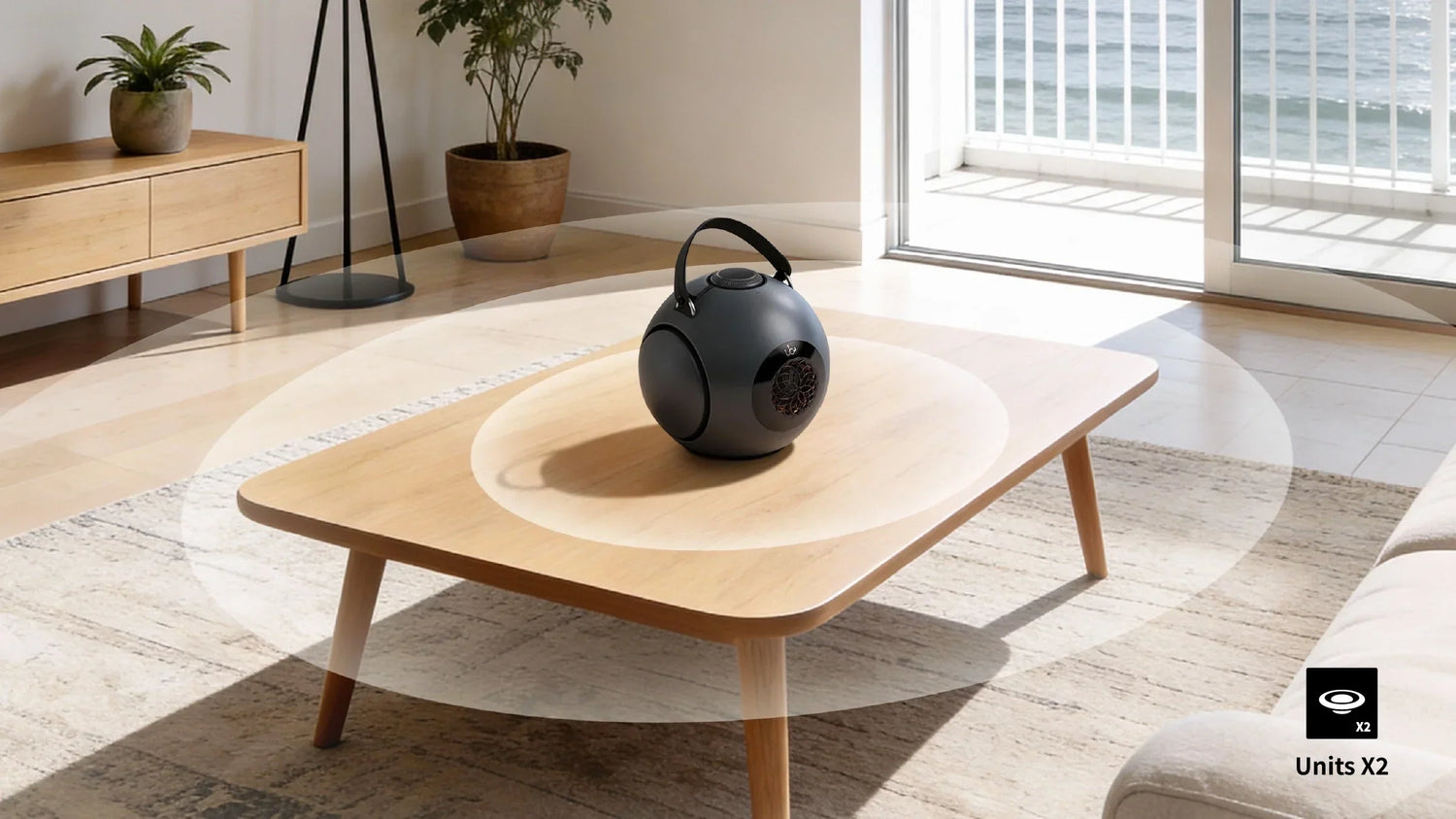
A spherical bluetooth speaker uses enclosure geometry as part of its acoustic system rather than treating the cabinet as a simple container for the driver and electronics. The shape changes how internal air pressure develops, how reflections behave inside the enclosure, how unwanted resonance is controlled, and how low-frequency energy is transferred into the surrounding room. For buyers comparing a sphere speaker, round bluetooth speaker, or premium portable audio system, understanding these physical principles is more useful than judging a speaker by size, wattage, or bass claims alone.
Why Speaker Shape Matters

A loudspeaker converts electrical energy into mechanical movement, and that movement creates pressure variations in air.
The enclosure controls what happens to that pressure before it reaches the listener.
A conventional rectangular cabinet contains multiple flat, parallel surfaces. Sound generated inside the enclosure can reflect between those surfaces, creating standing-wave patterns and unwanted resonances. These effects can color the response of the speaker and interfere with the accuracy of the original signal.
A sphere changes that geometry.
Instead of providing long parallel internal walls, a spherical enclosure distributes its internal surfaces continuously around the acoustic volume. The resulting geometry can reduce the conditions that encourage strong standing-wave behavior inside conventional box-shaped cabinets.
This does not mean that every spherical enclosure automatically sounds better. The driver, internal volume, acoustic tuning, materials, and mechanical architecture still determine the final result.
The important point is that shape is an acoustic variable.
What Happens to Bass Inside a Conventional Speaker?
Bass frequencies have long wavelengths.
That makes low-frequency behavior particularly sensitive to enclosure volume, internal pressure, driver excursion, and the interaction between the driver and cabinet.
In a conventional box, internal reflections can create pressure patterns that interfere with the driver's operation.
The cabinet therefore has to manage:
- Internal air pressure
- Resonance
- Standing waves
- Driver excursion
- Vibration
- Acoustic energy transfer
Poorly controlled internal behavior can contribute to coloration and distortion.
A carefully engineered enclosure attempts to control these effects before the sound reaches the outside environment.
Why a Sphere Is Different

A sphere has no parallel internal walls.
Its curved surface surrounds the internal volume continuously.
For acoustic engineering, that creates a different pressure environment from a rectangular cabinet.
In a spherical enclosure, pressure generated by a driver can distribute more uniformly around the internal volume instead of repeatedly reflecting between opposing flat surfaces.
This is particularly relevant when the enclosure is being used as an active component of the bass system.
The result can be:
- Reduced internal standing-wave behavior
- Lower unwanted resonance
- More consistent internal pressure distribution
- Reduced phase distortion
- Improved harmonic reproduction
The actual benefit depends on how the sphere is integrated with the driver and acoustic tuning.
A spherical cabinet by itself is not an acoustic solution. It becomes meaningful when the entire system is designed around the geometry.
Acoustic Spotlight: How UB+ Uses a Spherical 
The UB+ dB1 DoubleBass uses a patented spherical acoustic chamber inspired by the physics of Helmholtz Resonance.
The chamber is designed around controlled air-pressure behavior rather than simply placing a conventional driver inside a rounded enclosure.
At the center of the system, a 4.5-inch long-stroke mid-bass driver fires downward into the spherical chamber.
As the driver moves, it creates changing air pressure within the enclosed volume. That pressure activates two large passive radiators positioned symmetrically on opposite sides of the sphere.
The combined passive-radiator surface area is approximately 3.5× larger than the active woofer.
This arrangement increases the available radiating area for low-frequency energy while maintaining a compact physical enclosure.
The two passive radiators move in opposing directions, producing a self-cancelling vibration architecture. Mechanical forces that would otherwise cause unwanted cabinet movement are counteracted, allowing more of the driver's energy to be converted into acoustic output.
The resulting system provides mechanical bass amplification rather than depending primarily on artificial bass enhancement.
The driver assembly incorporates a 90 mm oversized neodymium magnet, 35 mm long-stroke voice coil, 20 mm piston movement, 18 mm extra-wide surround, and aluminum shorting ring.
The system is specified at approximately 40 Hz–20 kHz and around 93 dB SPL.
The DSP monitors system behavior, optimizes operation, and protects the driver, but it is not used as the fundamental mechanism for artificially generating the bass.
This is the key engineering distinction: the spherical chamber is not merely a visual design feature. It is integrated into the mechanical and acoustic pathway that produces low-frequency output.
Helmholtz Resonance Explained Simply
Helmholtz resonance is a physical acoustic phenomenon familiar from objects such as bottles.
When air is enclosed within a cavity with a controlled opening or acoustic path, the air mass and enclosed volume can interact to create a resonant frequency.
The principle is useful in loudspeaker design because acoustic resonance can be deliberately controlled to influence low-frequency behavior.
The UB+ approach draws inspiration from this physics and incorporates it into a spherical acoustic chamber.
The objective is not simply to make the speaker resonate more.
It is to control how pressure and acoustic energy behave within the enclosure.
That distinction is important.
Uncontrolled resonance can color sound.
Controlled resonance can become part of an acoustic design.
Why Bass Is Particularly Sensitive to Enclosure Geometry
Bass requires significant air movement.
The lower the frequency, the longer the wavelength and the greater the physical challenge of generating useful acoustic pressure from a compact enclosure.
A small speaker therefore faces several limitations simultaneously:
- Limited enclosure volume
- Limited driver diameter
- Limited excursion
- Limited electrical power
- Mechanical vibration
- Internal pressure management
Increasing amplifier power alone does not solve all of these problems.
The driver still has to move air.
The enclosure still has to control pressure.
And the mechanical system still has to prevent wasted energy.
This is why premium bluetooth speakers with good bass are often differentiated by their physical architecture rather than by amplifier wattage alone.
Mechanical Bass vs Digital Bass
Digital Signal Processing is extremely useful in modern speakers.
DSP can monitor:
- Driver excursion
- Thermal conditions
- Frequency response
- Protection thresholds
- Amplifier behavior
- System limits
It can also alter tonal balance.
But there is a fundamental difference between using DSP to manage a physical acoustic system and using DSP to create the impression of additional bass beyond what the hardware can naturally reproduce.
Heavy digital bass enhancement can increase low-frequency output, but it also has to operate within the physical limits of the driver and amplifier.
A mechanically optimized system approaches the problem differently.
Instead of asking software to compensate for an inefficient acoustic design, the physical components are engineered to produce useful acoustic output in the first place.
That is the principle behind mechanical bass amplification.
Why Passive Radiators Matter
Passive radiators are acoustic components that respond to pressure changes inside a speaker enclosure.
Unlike an active driver, they do not require their own voice-coil amplifier.
The active driver creates pressure.
That pressure moves the passive radiator.
This allows the enclosure to use additional radiating surfaces without adding another powered driver.
In compact speakers, passive radiators can be particularly useful because they help extend low-frequency performance without requiring a traditional bass-reflex port.
But passive-radiator performance depends on the complete acoustic system.
Their size, mass, compliance, enclosure volume, tuning, and relationship with the active driver all matter.
Simply adding a passive radiator does not guarantee better bass.
Why Symmetry Matters
The placement of acoustic components can influence mechanical behavior.
When two passive radiators are positioned symmetrically and move in opposing directions, their mechanical forces can counteract one another.
This is the basis of the self-cancelling vibration architecture used in the dB1.
Reducing cabinet movement matters because cabinet vibration represents energy that is not being converted directly into useful acoustic output.
An enclosure that moves excessively can also introduce unwanted mechanical coloration.
The goal is therefore not simply to make components move more.
It is to control where the energy goes.
Shape and 360-Degree Sound
The spherical concept also has implications for sound dispersion.
A conventional forward-facing speaker tends to establish a preferred listening axis.
Move away from that axis and the frequency response can change.
A spherical acoustic system can support broader distribution depending on the driver arrangement and enclosure architecture.
This makes a 360 degree bluetooth speaker particularly interesting for shared listening environments.
Instead of creating a single "best seat," a broader acoustic distribution can make the speaker more practical for:
- Living rooms
- Dining areas
- Outdoor gatherings
- Workspaces
- Social settings
However, enclosure shape alone does not create uniform 360-degree sound.
Driver placement, crossover behavior, frequency, enclosure geometry, and acoustic radiation patterns all contribute.
How Room Boundaries Affect Bass
The room itself becomes part of the listening system.
A speaker placed near a wall can produce different bass from the same speaker positioned in the middle of a room.
Corner placement can increase low-frequency reinforcement.
Moving the speaker away from boundaries can reduce that reinforcement.
Furniture, room dimensions, floor materials, and wall construction also affect reflections.
This means the same round speaker can sound different depending on where it is positioned.
The enclosure determines how the speaker produces acoustic energy.
The room determines how that energy interacts with the listener.
Placement Flexibility of a Spherical Speaker
One potential advantage of a spherical design is placement versatility.
A traditional speaker is often optimized around a front-facing orientation.
A spherical system can be less visually dependent on a particular direction because the enclosure itself does not establish a large flat front panel.
That makes it suitable for spaces where the speaker may be viewed and heard from multiple directions.
Potential placements include:
|
Location |
Why spherical design can be useful |
|
Living room |
Broad listening area |
|
Dining table |
Multiple listeners |
|
Home office |
Compact footprint |
|
Bedroom |
Flexible orientation |
|
Bookshelf |
Sculptural appearance |
|
Patio |
Shared listening |
|
Outdoor table |
Multiple listening positions |
Placement still matters, particularly for bass.
A sphere does not eliminate room acoustics.
Does a Spherical Speaker Automatically Have Better Bass?
No.
This is one of the most important distinctions for buyers.
A spherical enclosure can provide acoustic advantages, but performance depends on the entire system.
A serious evaluation should consider:
- Enclosure volume
- Driver excursion
- Driver motor strength
- Passive-radiator design
- Acoustic tuning
- Internal pressure behavior
- Mechanical vibration
- Amplifier capability
- DSP implementation
- Frequency response
A poorly engineered sphere can perform worse than a well-engineered rectangular speaker.
The shape is an engineering tool, not a guarantee.
Why Spherical Design Can Be Valuable for Compact Speakers
Compact speakers face severe physical constraints.
There is limited space for:
- Driver displacement
- Acoustic volume
- Passive-radiator area
- Battery
- Amplifier
- Electronics
A carefully designed spherical architecture can use the available volume efficiently while minimizing some of the internal acoustic problems associated with conventional boxes.
This is especially relevant for buyers who want a compact bluetooth speaker with deep bass without moving to a much larger cabinet.
The objective is not to defeat the laws of acoustics.
It is to use those laws more efficiently.
Spherical vs Rectangular Speaker Architecture
|
Acoustic consideration |
Conventional rectangular enclosure |
Spherical enclosure |
|
Parallel internal surfaces |
Common |
Eliminated |
|
Internal reflection paths |
Strongly influenced by flat walls |
Distributed by curved geometry |
|
Internal pressure distribution |
Depends heavily on cabinet geometry |
More uniformly distributed |
|
Standing-wave behavior |
Requires careful control |
Geometry can reduce parallel-wall modes |
|
Phase behavior |
Dependent on enclosure and driver design |
Can benefit from spherical pressure distribution |
|
Mechanical vibration |
Depends on cabinet construction |
Can be managed through symmetrical architecture |
|
Placement appearance |
Directional visual orientation |
More visually orientation-neutral |
|
Bass performance |
Highly design-dependent |
Highly design-dependent |
|
360° potential |
Driver arrangement required |
Geometry can support broader radiation |
|
Acoustic outcome |
Depends on complete system |
Depends on complete system |
The final row is the most important.
Neither shape automatically produces superior sound.
The complete acoustic system determines the result.
What Audiophile Buyers Should Actually Evaluate
A buyer considering a sphere speaker should look beyond the shape.
Driver Control
A strong motor system and controlled excursion are essential for accurate low-frequency reproduction.
Enclosure Volume
A small cabinet imposes physical limitations that must be addressed through engineering rather than marketing.
Resonance Management
Ask how the enclosure controls unwanted internal modes.
Passive-Radiator Design
If passive radiators are used, examine their role in the acoustic system rather than simply counting them.
Frequency Response
A claimed frequency range should be considered alongside measurement conditions and output level.
Distortion
Bass extension without control can produce audible distortion.
Dispersion
Evaluate how the speaker behaves as the listener moves around it.
Mechanical Stability
A speaker should convert as much energy as possible into acoustic output rather than unwanted cabinet vibration.
Why the Enclosure Should Be Treated as a Component
In basic speaker designs, it is easy to think of the cabinet as a box that holds the electronics.
Acoustically, that is incomplete.
The enclosure determines:
- Internal volume
- Air pressure
- Resonance
- Driver loading
- Passive-radiator behavior
- Structural vibration
- Reflection paths
Changing the enclosure changes the acoustic system.
That is why a spherical cabinet can represent a meaningful engineering decision rather than merely an industrial-design choice.
Who Should Consider a Spherical Bluetooth Speaker?
A spherical design is particularly relevant for buyers who prioritize:
Premium Design
The speaker can function as part of the room rather than appearing like conventional electronics.
Bass Performance
A carefully engineered spherical system can use controlled pressure and passive-radiator behavior to improve low-frequency reproduction.
Flexible Placement
The form works naturally in environments where listeners are positioned around the speaker.
Compact Audio
The architecture can provide a path toward higher acoustic performance without simply increasing cabinet dimensions.
Engineering-Led Products
Buyers interested in physical acoustic mechanisms may prefer an enclosure where the shape has a direct technical purpose.
Who May Prefer a Conventional Speaker?
A conventional rectangular speaker can still be the better choice when the buyer specifically wants:
- Strong stereo separation from two directional speakers
- Traditional bookshelf placement
- Front-facing listening
- Easy wall mounting
- A specific stereo configuration
- A large cabinet optimized around conventional driver placement
There is no universal enclosure shape that is correct for every application.
The question is whether the physical design matches the listening objective.
Buying Checklist for a Spherical Bluetooth Speaker
Before purchasing, evaluate:
- Acoustic chamber: Is the sphere part of the acoustic system or primarily cosmetic?
- Driver: What type of driver and excursion system does it use?
- Bass architecture: Is low-frequency output mechanically supported?
- Passive radiators: How are they positioned and tuned?
- Resonance control: How does the enclosure manage internal reflections?
- Dispersion: How does sound change as you move around the speaker?
- Frequency response: What is the stated operating range?
- Distortion: Is bass controlled at realistic listening levels?
- Connectivity: Is the wireless platform current and reliable?
- Battery: Does operating time match your intended use?
- Durability: Is the construction appropriate for the environment?
- Price: Are you paying for actual acoustic engineering rather than appearance alone?
Frequently Asked Questions
Does a spherical speaker produce better bass?
Not automatically. Spherical geometry can reduce parallel-wall reflection patterns and support more uniform internal pressure distribution, but bass quality ultimately depends on the complete driver, enclosure, passive-radiator, amplifier, and acoustic-tuning system.
Why does speaker shape affect sound?
The enclosure determines how internal acoustic energy behaves. Curved geometry changes reflection paths, pressure distribution, resonance behavior, and the way the driver interacts with the enclosed air.
What is a Helmholtz Resonance-inspired speaker?
It is a speaker design that draws on the acoustic behavior of a Helmholtz resonator, using controlled air volume and acoustic pressure behavior as part of its low-frequency design.
Are spherical speakers better for 360-degree sound?
They can be well suited to broad sound distribution, but a spherical enclosure alone does not guarantee uniform 360-degree output. Driver placement and acoustic radiation patterns remain critical.
Is a spherical speaker good for a living room?
Yes, particularly when multiple listeners are positioned around the room. Placement should still be considered because walls, corners, floors, and furniture affect bass and reflections.
Does Shape Really Change How Bass Moves Through a Room?
Yes but not because a sphere is inherently better than a box.
The important advantage comes from what the geometry allows the engineer to control.
A spherical enclosure removes parallel internal walls, changes reflection paths, supports more uniform internal pressure behavior, and can become an active part of a mechanically engineered bass system. When combined with controlled driver excursion, passive-radiator tuning, and vibration management, the shape can contribute directly to the way low-frequency energy is produced.
The UB+ dB1 DoubleBass demonstrates this approach by making the spherical acoustic chamber central to its design rather than using the shape only as an aesthetic feature.
For buyers considering a spherical bluetooth speaker, the strongest reason to consider this architecture is therefore not appearance alone. It is the possibility of integrating enclosure geometry, pressure behavior, mechanical bass amplification, resonance control, and sound dispersion into one acoustic system.
The right question is not:
"Is a sphere better than a box?"
It is:
"What does the manufacturer actually do with the sphere?"
If the geometry is connected to the driver system, pressure management, resonance control, passive-radiator architecture, and mechanical behavior, the shape becomes an engineering decision.
That is where spherical speaker design becomes genuinely interesting for serious listeners.
Explore the UB+ Acoustic Approach
→ Compare dB1 vs dB Mini
Explore UB+'s speaker designs and see how their acoustic architectures differ.
→ See Color Options
View the available finishes and choose a design suited to your space.
→ Check Current Price
Visit UB+ for current specifications, product information, pricing, and availability.


留言
此網站已受到 hCaptcha 保護,且適用 hCaptcha 隱私政策以及服務條款。