
If your Bluetooth speaker sounds thin, boomy, or distorted when you turn up the volume, buying a new speaker is not always the first solution. Speaker placement, room interaction, EQ, listening volume, enclosure design, and acoustic loading can all affect how much bass you actually hear.
Learning how to get deeper bass from a Bluetooth speaker starts with understanding one simple principle: bass is not created by volume alone. Low frequencies require air movement, and the way a speaker manages that air can make the difference between bass that sounds deep and bass that simply sounds louder.
Even a compact speaker can perform differently depending on where it sits and how it is tuned. A speaker placed against a wall may produce more perceived low end than the same speaker sitting in the middle of a room. A carefully adjusted EQ can improve balance, while excessive bass boost can create distortion.
There is also a point where setup improvements reach their physical limit. If the enclosure, driver, and acoustic system are not designed to produce controlled low frequencies, placement and EQ can only do so much.
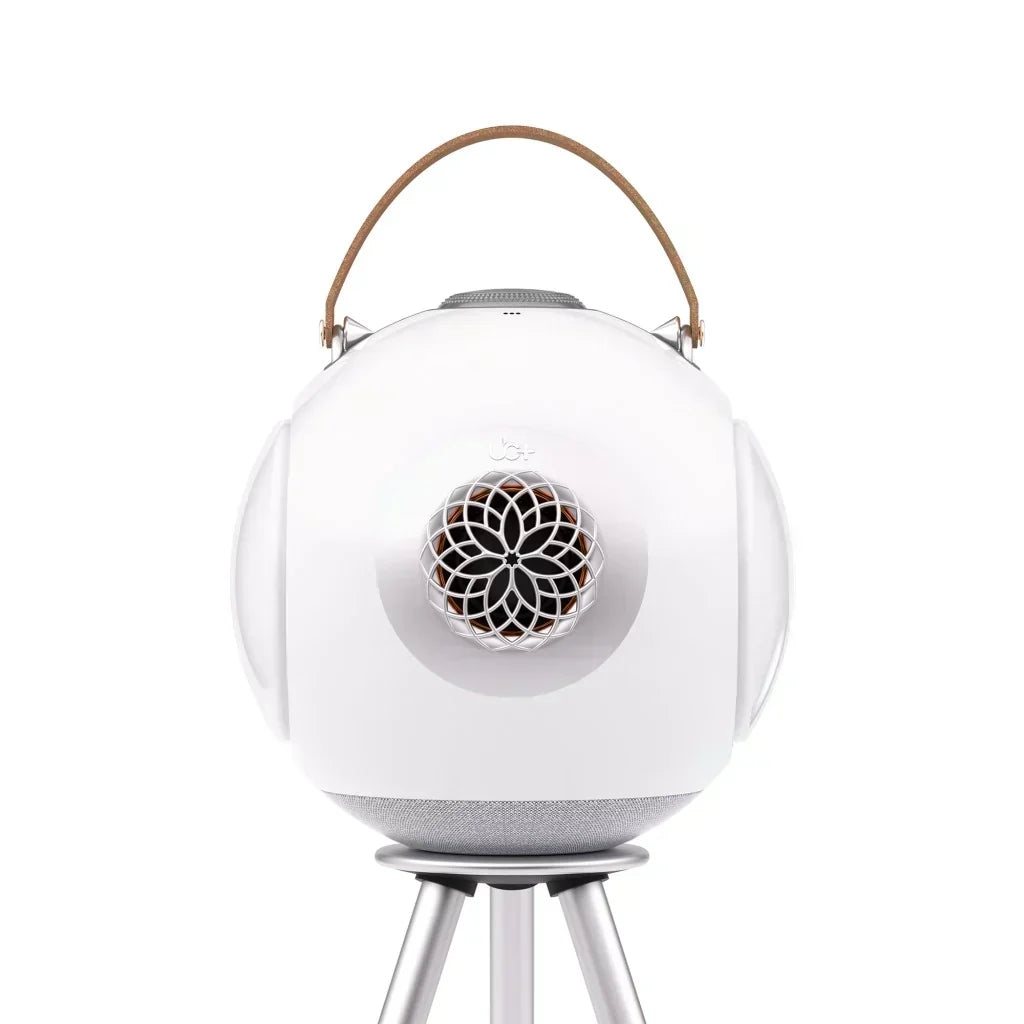
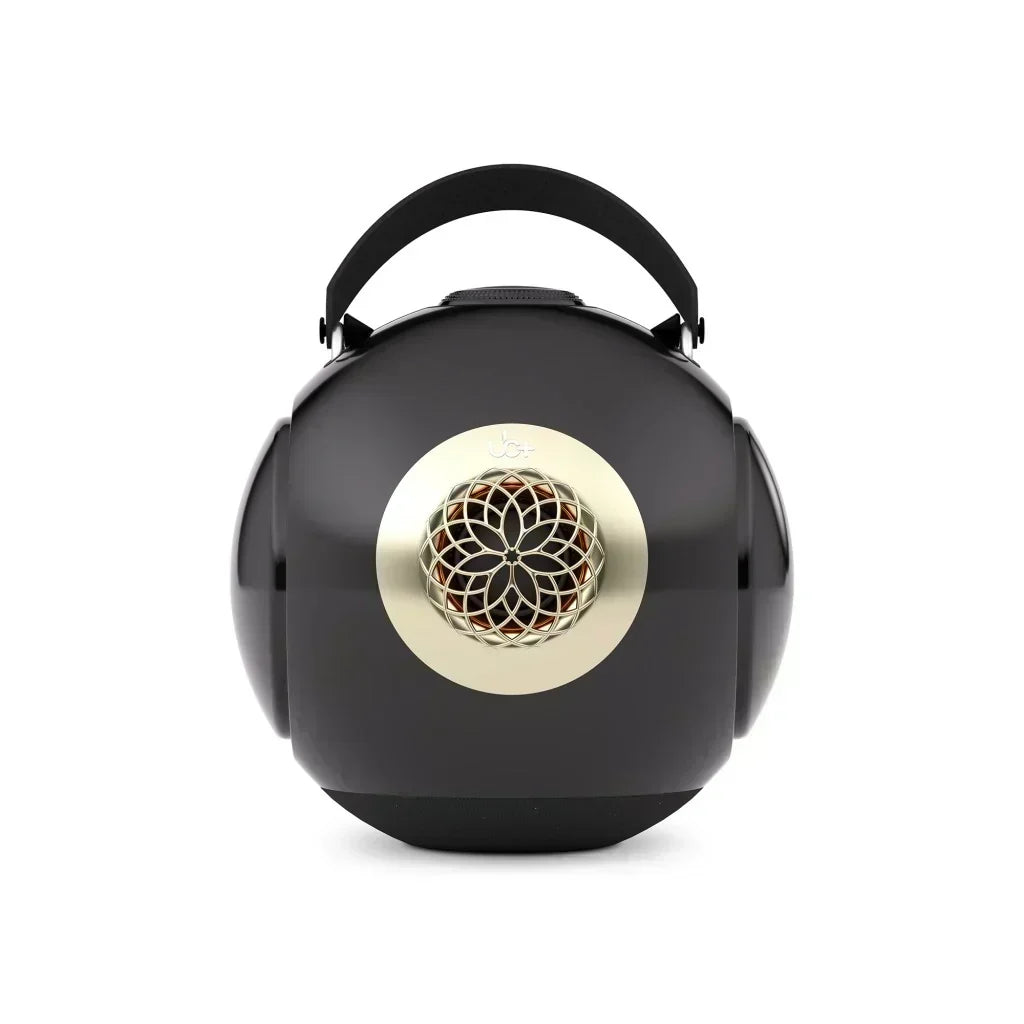
That is where the engineering behind the UB+ dB1 DoubleBass becomes relevant. Its spherical acoustic chamber, downward-firing mid-bass driver, and symmetrical passive-radiator architecture approach bass reproduction as an acoustic problem rather than simply an electronic volume problem.
Why Small Bluetooth Speakers Struggle With Deep Bass

Low frequencies are physically demanding.
A bass note at 40Hz has a much longer wavelength than a midrange or treble frequency. Reproducing it at useful volume requires the speaker system to move enough air without exceeding the limits of the driver or enclosure.
Compact Bluetooth speakers have several constraints:
- Limited internal enclosure volume
- Small physical footprint
- Restricted driver excursion
- Battery-power limitations
- Mechanical vibration
- Internal acoustic reflections
- Thermal and amplifier limitations
This is why a small speaker can sometimes sound surprisingly powerful but still fail to reproduce genuinely deep bass with control.
Some designs use DSP to increase the perception of bass. Digital processing can be useful, particularly for protecting the driver and balancing the frequency response, but aggressive boosting cannot remove the physical limitations of a small enclosure.
The more useful question is therefore not simply “How much bass does the speaker have?”
It is:
How efficiently does the entire speaker system move and control air?
For a broader look at the specifications that actually matter when comparing speakers, see 7 Key Speaker Specifications That Actually Matter.
Start With Speaker Placement

Before changing EQ settings or buying equipment, experiment with placement.
The relationship between a speaker and the room can significantly affect perceived bass.
Low frequencies interact strongly with boundaries such as walls, floors, and corners. Moving a speaker closer to a boundary can increase low-frequency reinforcement, while moving it into a more open position can reduce that effect.
Try several positions rather than assuming there is one universally correct location.
Move the Speaker Closer to a Wall
A speaker positioned relatively close to a wall can produce stronger perceived bass because the nearby boundary changes how low-frequency energy interacts with the room.
If your speaker sounds thin in the center of a room, try moving it closer to a wall and listen again.
Do not move it immediately into a corner, however. Corners can produce substantial reinforcement but may also emphasize particular frequencies and create boomy or uneven bass.
Test Several Heights
Speaker height can also change the way low-frequency energy interacts with nearby surfaces.
Try listening with the speaker:
- On a desk
- On a shelf
- On a lower table
- On a firm floor surface
Listen for changes in bass weight, clarity, and definition.
You may find that a small positioning adjustment produces a more noticeable improvement than a large EQ change.
For more practical guidance, see the existing UB+ article on improving Bluetooth speaker sound quality.
Don't Confuse Louder Bass With Deeper Bass

One of the most common mistakes when adjusting a Bluetooth speaker is simply increasing the bass control.
More bass does not automatically mean deeper bass.
Imagine two speakers playing the same track. One produces a large amount of energy around the upper-bass region, while the other reaches lower frequencies but at a more controlled level.
The first speaker may sound more powerful initially.
The second may actually sound deeper.
This distinction matters because excessive upper-bass energy can make music sound thick or boomy without providing genuine low-frequency extension.
Deep bass should have definition, timing, and integration with the rest of the frequency range.
If the bass overwhelms vocals, guitars, keyboards, or percussion, the problem may not be a lack of bass. It may be too much energy in the wrong region.
Use EQ Carefully
If your phone, streaming application, or speaker provides an EQ, small adjustments can help.
Avoid immediately moving the bass slider to maximum.
Instead, make gradual changes and listen to familiar tracks.
A useful approach is to:
- Start with a neutral EQ.
- Increase bass slightly.
- Listen for distortion or muddiness.
- Reduce excessive upper-bass energy if vocals become masked.
- Compare the result at both low and moderate volume.
The goal is not to make the speaker produce the maximum possible bass.
The goal is to make the bass sound full without losing clarity.
If you have already reached the point where increasing EQ simply makes the speaker distort, you have probably reached a hardware limitation rather than an EQ problem.
Room Size Can Change the Way Bass Sounds
The same Bluetooth speaker can sound very different in two rooms.
A small bedroom may naturally reinforce certain low frequencies. A larger open-plan living area may make the same speaker sound lighter.
Room boundaries, furniture, flooring, and reflective surfaces all influence what reaches your ears.
This is why a speaker should not be judged only by listening to it in one location.
If your speaker sounds weak in a large room, try moving closer to it before assuming the speaker has no bass.
You can also experiment with the position of furniture and other surfaces around the listening area.
For a deeper explanation of this effect, see Room Acoustics Basics: Why the Same Speaker Sounds Different in Different Rooms.
Give the Speaker a Solid Surface
The surface beneath a speaker can also affect what you hear.
A soft surface can absorb or mechanically isolate some of the energy produced by the speaker. A firm surface can behave differently.
This does not mean that every speaker should be placed directly on the floor.
Instead, test different surfaces and listen.
For a compact Bluetooth speaker, a stable desk, shelf, or table may provide a different acoustic result from a soft bed, couch, or thick fabric surface.
The important thing is to test rather than assume.
Why Driver Size Alone Doesn't Tell You the Bass Story
It is tempting to compare Bluetooth speakers by driver diameter.
A larger driver can move more air under the right conditions, but driver size alone does not determine bass performance.
The final result depends on the complete acoustic system:
|
Factor |
Why It Matters for Bass |
|
Driver excursion |
Determines how far the driver can move air |
|
Enclosure volume |
Influences internal pressure and acoustic loading |
|
Passive radiators |
Can extend low-frequency output |
|
Port design |
Uses tuned air movement to reinforce bass |
|
Chamber geometry |
Influences internal pressure and resonances |
|
DSP |
Can shape response and protect the system |
|
Placement |
Changes room reinforcement |
|
Surface interaction |
Can affect mechanical and acoustic behavior |
This is why two speakers with similar driver sizes can produce noticeably different bass.
The speaker is a system, not simply a driver inside a box.
Passive Radiators Can Help a Compact Speaker Go Deeper
Passive radiators are particularly useful when designers want additional low-frequency output without relying on a conventional port.
A passive radiator is an unpowered diaphragm that responds to pressure changes inside the enclosure.
The active driver creates movement in the enclosed air. That pressure excites the passive radiator, which then contributes additional acoustic output.
This allows the system to extend low-frequency performance without requiring the same type of open airflow path used in a ported design.
However, passive radiators are not automatically better simply because they are passive radiators. Their size, tuning, excursion, enclosure volume, and integration with the active driver all matter.
UB+ explains this broader principle in How Passive Radiators Work in Bluetooth Speakers.
Why the dB1 DoubleBass Uses Two Passive Radiators
The UB+ dB1 DoubleBass takes the passive-radiator concept further by using two large radiators positioned symmetrically on opposite sides of the spherical enclosure.
The system combines:
- A central mid-bass driver
- A spherical acoustic chamber
- Two opposing passive radiators
- Symmetrical mechanical movement
- Controlled internal air pressure
The combined passive-radiator surface area is approximately 3.5 times the area of the active woofer.
That large radiating area gives the system more physical surface through which low-frequency energy can be converted into acoustic output.
The symmetrical arrangement also serves a mechanical purpose.
When the opposing radiators move in equal and opposite directions, their mechanical forces can counterbalance each other. Rather than allowing the enclosure to react strongly in one direction, the system is designed around balanced movement.
This is an important distinction between simply adding a passive radiator and engineering the entire speaker around passive-radiator behavior.
Why the Spherical Enclosure Matters
The enclosure is one of the least appreciated parts of a Bluetooth speaker.
Many compact speakers use rectangular or cylindrical structures because those shapes are practical for manufacturing, packaging, and component placement.
The dB1 takes a different approach.
Its spherical chamber is inspired by principles associated with Helmholtz resonance, using the enclosure's air volume as part of the acoustic system.
A sphere also avoids the long parallel internal surfaces found in many conventional box-shaped enclosures.
That changes the way internal pressure and reflections behave.
Instead of treating the enclosure as an empty container around the driver, the design treats the chamber as an active part of the acoustic architecture.
This is particularly relevant when the goal is controlled low-frequency reproduction from a compact speaker.
The Downward-Firing Driver Has a Specific Job
The dB1's mid-bass driver is positioned to fire downward into the internal acoustic chamber.
That means the driver is not simply projecting sound directly toward the listener.
Instead, it energizes the internal air volume first.
The pressure created inside the chamber then interacts with the passive-radiator system.
This architecture connects several physical elements:
Driver → Air Volume → Spherical Chamber → Passive Radiators → Acoustic Output
The benefit of this approach is that the enclosure and air movement participate in the production of bass rather than leaving the driver to do all of the work mechanically.
Why Air Loading Matters
The phrase air loading can sound technical, but the basic concept is straightforward.
A driver moves.
That movement changes pressure inside the enclosure.
The enclosure controls that pressure.
The passive radiators respond to it.
The resulting acoustic energy is then released into the surrounding environment.
When those components are properly integrated, the system can produce useful low-frequency output without simply demanding more excursion from the active driver.
This is one reason acoustic architecture matters so much in compact speakers.
Can You Make Any Bluetooth Speaker Produce Deeper Bass?
To a point.
Placement can improve room reinforcement.
EQ can improve tonal balance.
Changing listening position can change perceived bass.
A solid surface can sometimes improve mechanical stability.
But these techniques cannot fundamentally change the physical limits of the speaker.
If the driver cannot reproduce a frequency with sufficient output, EQ cannot magically create it without demanding more from the hardware.
If the enclosure cannot manage the resulting pressure, additional bass boost can produce distortion rather than useful extension.
And if the speaker has poor acoustic loading, moving it around the room will not completely change its underlying architecture.
At that point, the solution is not another EQ adjustment.
It is a different speaker design.
When Bass Sounds Boomy Instead of Deep
Boomy bass is often confused with powerful bass.
The difference is important.
Deep bass gives you the sense of low-frequency extension while preserving separation and timing.
Boomy bass tends to concentrate energy around certain frequencies, making individual bass notes less distinct.
If your speaker sounds boomy, try:
- Moving it away from a corner
- Reducing the bass EQ slightly
- Moving it closer or farther from a wall
- Changing the listening position
- Testing another room
- Lowering the volume
Sometimes reducing bass produces the perception of more usable bass because the remaining low frequencies become easier to distinguish.
Why Turning the Volume Down Can Sometimes Help
This sounds counterintuitive, but it is worth testing.
A small speaker pushed close to its limits may compress or distort low-frequency information.
As the volume increases, the driver may have less available excursion for clean reproduction. DSP protection can also change the output behavior at higher levels.
If you reduce the volume slightly, the speaker may sound cleaner and more balanced.
The result can actually feel more satisfying because bass notes remain recognizable instead of turning into a continuous low-frequency blur.
Good bass is not simply about how hard a speaker can be pushed.
It is about how well it maintains control while playing.
What the dB1 Changes About the Equation
The UB+ dB1 DoubleBass approaches compact bass reproduction from the physical side.
Its design combines:
- A spherical acoustic chamber
- Helmholtz-inspired acoustic principles
- A downward-firing mid-bass driver
- Two symmetrical passive radiators
- Large combined passive-radiator surface area
- 360° sound dispersion
The objective is to let the acoustic system handle more of the low-frequency workload.
Instead of depending entirely on electronic bass enhancement, the enclosure, air volume, driver, and radiators are designed to work together.
That is the important distinction.
The dB1 is not simply trying to make bass louder.
It is designed around how air moves through the speaker.
40Hz Bass: Why Frequency Extension Is Only Part of the Story
A speaker's lowest published frequency can be useful information, but it should not be interpreted in isolation.
A frequency-response number does not tell you how loud that frequency is reproduced, how much distortion occurs, or how the system behaves across the rest of the range.
A speaker reaching toward 40Hz is interesting because that enters a substantially lower region than the upper-bass frequencies emphasized by many compact systems.
But good bass is still about the complete response.
You want low frequencies that integrate with vocals, instruments, percussion, and the rest of the music.
This is why bass extension and bass quality are not the same thing.
What You Can Do Today With Your Existing Speaker
Before replacing your speaker, try this simple process.
Start With Placement
Move the speaker around the room.
Test a wall position, a more open position, and a different height.
Reset the EQ
Start neutral.
Then make small changes rather than immediately applying maximum bass boost.
Reduce the Volume Slightly
If the speaker becomes muddy or distorted at high volume, compare it at a lower level.
Change Your Listening Position
Move closer to the speaker and listen from different parts of the room.
Test Familiar Music
Use tracks you know well.
Listen specifically for:
- Bass extension
- Bass definition
- Vocal clarity
- Kick-drum impact
- Distortion
- Muddiness
Test the Speaker on Different Surfaces
Compare a solid desk or table with softer surfaces.
These simple experiments can reveal whether your bass problem is primarily caused by placement, room interaction, EQ, or the speaker itself.
When You Need a Different Acoustic Architecture
If you have tried placement, EQ, volume adjustments, and different surfaces but your speaker still sounds thin or distorted, you may have reached the physical limit of the system.
That is when enclosure architecture becomes important.
A speaker with a carefully engineered chamber, appropriate driver excursion, passive-radiator system, and controlled internal pressure has more physical tools available for producing low frequencies.
The UB+ dB1 DoubleBass is built around that philosophy.
Its spherical chamber and DoubleBass architecture are not separate marketing features. They are connected elements of the acoustic system.
A Better Way to Think About Bluetooth Speaker Bass
Instead of asking:
“How many watts does this speaker have?”
Ask:
“How does this speaker move air?”
Then consider:
- How large is the active driver?
- How much excursion does it have?
- Does the enclosure use a port or passive radiator?
- How is the internal air volume managed?
- What is the enclosure geometry?
- How does the speaker control vibration?
- How does it behave at higher volume?
- How does the room affect its output?
Those questions tell you much more about bass performance than a single power number.
If you're researching the broader differences between portable speaker designs, the existing Bluetooth Speaker Buying Guide is a useful next step.
What About 360° Sound?
Bass is only one part of the experience.
How sound spreads through a room also affects how large and immersive a speaker feels.
A conventional directional speaker creates a preferred listening axis. A 360° speaker takes a broader approach, distributing sound around the enclosure.
This can be useful when people move around the room or when there is no single listening position.
The dB1's spherical architecture is designed around this broader presentation.
For a deeper explanation of the difference, see 360° vs. Front-Firing Speakers.
Deeper Bass Is About Control
The biggest lesson is that deeper bass does not necessarily require more volume.
It requires the speaker to control air movement effectively.
Your existing speaker may improve considerably through placement, room positioning, EQ, and sensible listening levels.
But there are physical limits.
When the enclosure, driver, and acoustic system reach those limits, adding more bass through EQ can produce distortion rather than genuine low-frequency extension.
That is why acoustic architecture matters.
The UB+ dB1 DoubleBass approaches the problem through a spherical chamber, controlled air loading, a downward-firing driver, and dual symmetrical passive radiators.
The goal is not simply to make the speaker sound bigger.
It is to make the physical system work more efficiently.
Frequently Asked Questions
How can I get deeper bass from my Bluetooth speaker?
Start with placement. Move the speaker closer to a wall, test different heights, experiment with solid surfaces, and adjust EQ gradually. If the speaker still lacks low-frequency extension, the limitation may be physical rather than related to setup.
Does putting a Bluetooth speaker in a corner increase bass?
It can increase perceived bass because room boundaries reinforce low-frequency energy. However, corners can also create uneven or boomy bass, so compare a corner position with a wall position and a more open location.
Does turning up the bass EQ make bass deeper?
Not necessarily. Bass EQ can increase the amount of low-frequency energy, but excessive boosting can cause distortion or muddiness. Deeper bass depends on the speaker's physical ability to reproduce lower frequencies.
Do passive radiators improve Bluetooth speaker bass?
A properly designed passive-radiator system can extend low-frequency output by responding to pressure changes inside the enclosure. Its performance depends on radiator size, tuning, enclosure volume, driver behavior, and overall system integration.
Why does the UB+ dB1 use a spherical enclosure?
The dB1 uses spherical geometry as part of its acoustic architecture. The chamber is designed around controlled internal air pressure and Helmholtz-inspired principles, while the driver and passive radiators work together to produce low-frequency output.
Can placement make a small Bluetooth speaker sound much better?
Yes. Room boundaries and surfaces can substantially affect perceived bass and overall tonal balance. Placement cannot overcome the fundamental limits of a speaker, but it can make a significant difference to how that speaker performs in a particular room.
Final Thoughts
Getting deeper bass from a Bluetooth speaker is not simply about turning up the bass control.
Start with the room.
Experiment with placement, surfaces, listening position, EQ, and volume. These changes can often improve bass definition without spending anything.
But if the underlying speaker architecture is limiting low-frequency performance, there is only so much setup can accomplish.
That is where designs such as the UB+ dB1 DoubleBass take a different approach. Its spherical acoustic chamber, downward-firing mid-bass driver, and dual symmetrical passive radiators are designed to work together as a complete acoustic system.
The principle is simple:
Don't just push more power into the speaker. Make the air work more effectively.
Explore UB+ Speakers
→ Explore the UB+ dB1 DoubleBass
→ Explore UB+ Speakers
→ Check Current Price


Leave a comment
This site is protected by hCaptcha and the hCaptcha Privacy Policy and Terms of Service apply.