
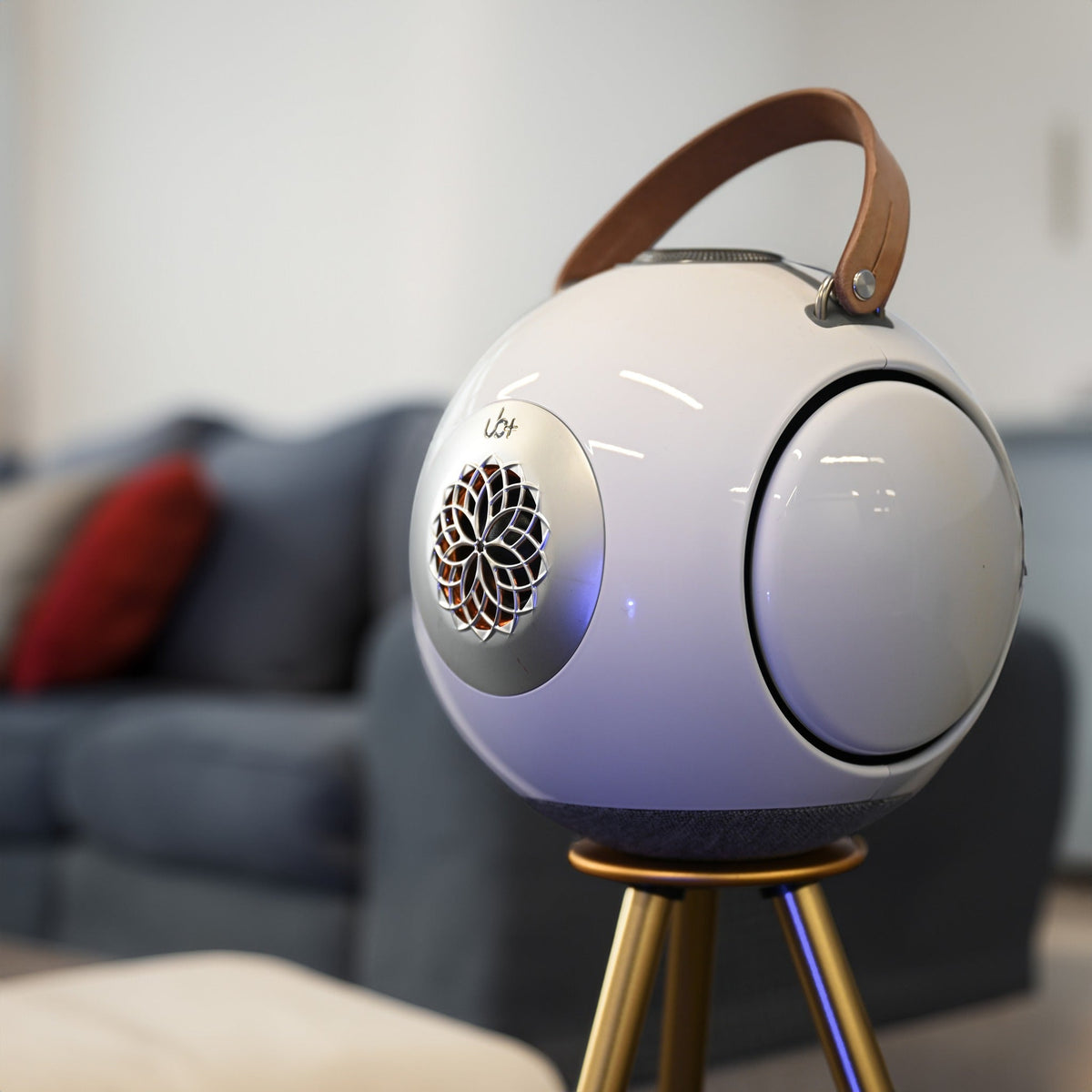
Choosing a portable speaker is not simply about finding the loudest model or the design with the biggest bass claim. Speaker geometry, driver arrangement, acoustic loading, dispersion, connectivity, and intended use all influence how a speaker performs in a real listening environment.
This becomes especially interesting when comparing the UB+ dB1 DoubleBass, a spherical Bluetooth sphere speaker, with popular cylindrical portable speakers. Cylinder speakers have become common because their elongated shape is practical, easy to carry, and well suited to compact wireless audio systems. The dB1 takes a fundamentally different approach, using a spherical acoustic chamber, a downward-firing mid-bass driver, and two opposing passive radiators as interconnected parts of its acoustic architecture.
That makes the comparison about more than appearance. It is a comparison between two different approaches to enclosure design, bass reproduction, sound dispersion, mechanical stability, portability, and everyday listening.
Why Speaker Shape Matters

Speaker shape is not merely an industrial-design decision. The enclosure becomes part of the acoustic system, influencing how internal air pressure, reflections, vibration, and sound radiation behave.
A typical cylindrical portable speaker has an elongated enclosure with drivers positioned to project sound outward from a defined area. This approach is practical because the speaker can be placed horizontally or vertically and transported easily. Its shape also allows manufacturers to package drivers, electronics, batteries, and passive elements efficiently.
The UB+ dB1 approaches the enclosure differently.
Its spherical chamber is designed around principles inspired by Helmholtz resonance, using the geometry of the enclosure to manage internal air pressure and acoustic behavior. Rather than treating the cabinet as a simple container around the driver, the sphere becomes an active part of the acoustic system.
The dB1 also uses two opposing passive radiators. Their symmetrical movement helps balance mechanical forces within the enclosure while contributing to low-frequency output.
This does not mean that every cylinder speaker sounds identical, or that enclosure shape alone determines sound quality. The more useful question is what each engineering approach is trying to accomplish.
For more background on spherical acoustic design, see How spherical speaker design changes modern home audio.
UB+ dB1 vs Conventional Cylinder Speakers
|
Feature |
UB+ dB1 DoubleBass |
Popular Cylinder Speakers |
|
General enclosure approach |
Spherical acoustic enclosure |
Cylindrical/rounded portable enclosure |
|
Acoustic architecture |
Spherical chamber with dual opposing passive radiators |
Model-dependent |
|
Driver orientation |
Downward-firing mid-bass driver |
Usually outward/front/side-firing depending on design |
|
Sound dispersion |
360° spherical presentation |
Depends on driver arrangement |
|
Bluetooth |
Bluetooth 5.3 |
Varies by model |
|
Water resistance |
IPX5 |
Varies by model |
|
Primary design emphasis |
Acoustic architecture and room-filling sound |
Portability, convenience and compact packaging |
|
Bass approach |
Mechanical acoustic loading + passive radiators |
Varies by enclosure, drivers and DSP |
|
Form factor |
Spherical |
Cylindrical/elongated |
The important distinction is that the dB1 does not use its unusual shape simply to look different. The spherical enclosure is connected directly to its acoustic architecture.
The UB+ dB1: A Different Acoustic Architecture

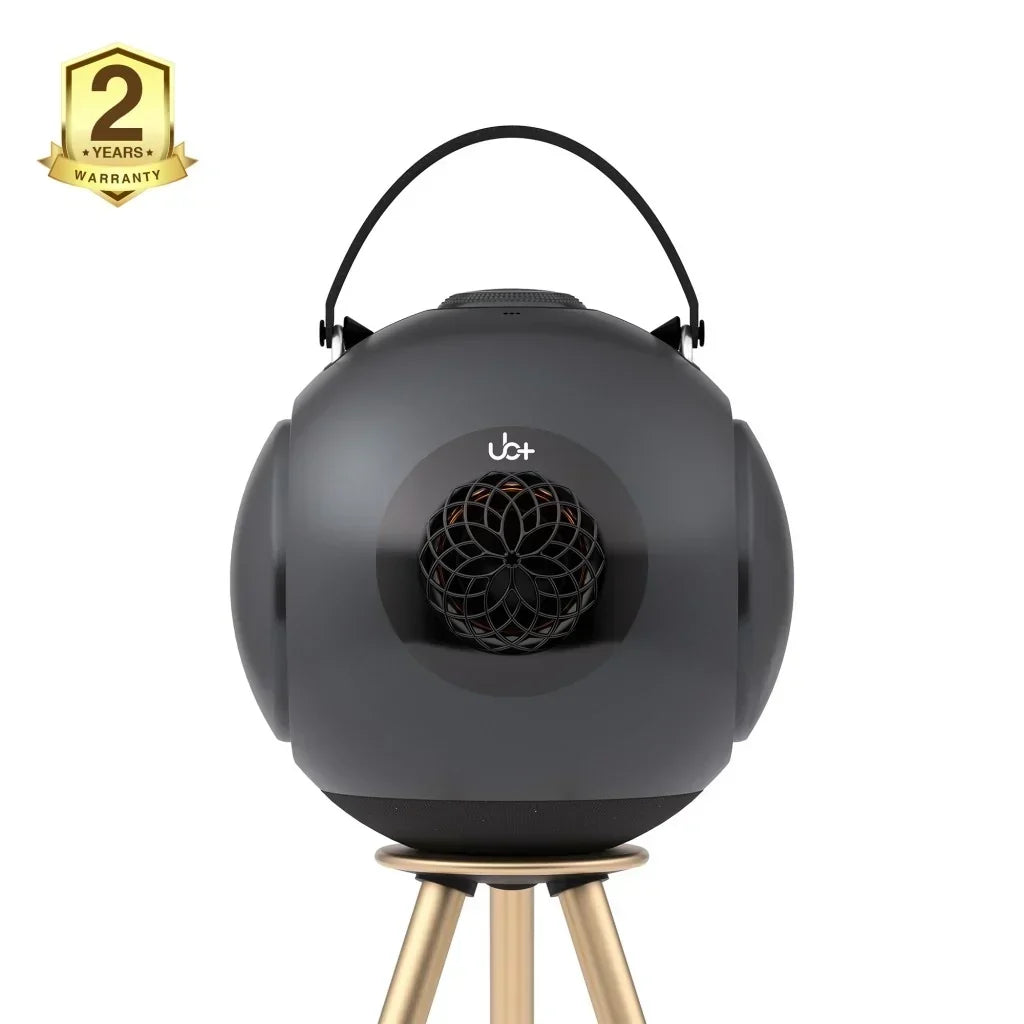
The defining difference of the UB+ dB1 is its spherical acoustic chamber.
The enclosure is not simply shaped like a sphere for visual differentiation. Its internal geometry is part of the acoustic design. A spherical chamber distributes internal pressure more symmetrically than a conventional box-like structure and is intended to reduce problematic internal resonances and standing-wave behavior.
The dB1 combines that chamber with:
- A 4.5-inch long-stroke mid-bass driver
- A downward-firing driver arrangement
- Two large passive radiators positioned opposite each other
- Approximately 3.5× the active woofer area in combined passive-radiator surface
- An oversized 90 mm neodymium magnet
- A long-stroke motor system
- 360° sound dispersion
- Bluetooth 5.3 connectivity
- IPX5 water resistance
The important point is not simply the number of components. These components are designed to operate as one acoustic system.
The spherical enclosure manages the internal air volume, the downward-firing driver energizes that chamber, and the opposing passive radiators convert the resulting pressure into additional low-frequency output.
For a deeper explanation of the concept, read How spherical speaker design changes modern home audio.
Cylinder Speakers: Why This Form Factor Is So Common
Cylindrical speakers have become popular because the form factor solves several practical problems at once.
An elongated enclosure can accommodate a battery, electronics, drivers, passive elements, and controls without requiring a large footprint. It can also be placed on a table, shelf, desk, or outdoor surface without taking up much space.
For portable listening, these are meaningful advantages.
Many cylinder speakers are designed around a combination of compact drivers, passive radiators, digital signal processing, and carefully tuned enclosures. The result can be impressive sound from a relatively small product.
However, cylindrical architecture also creates a different acoustic environment inside the enclosure.
Depending on the specific design, internal reflections and pressure patterns can develop along the length of the cabinet. Engineers use damping, driver positioning, internal bracing, passive radiators, ports, and DSP to manage these behaviors.
The dB1 takes another route.
Instead of starting with a conventional elongated cabinet and correcting its acoustic behavior, UB+ makes the spherical chamber itself part of the solution.
That difference is central to understanding the dB1.
Bass Performance: Mechanical Acoustic Loading vs Conventional Tuning

Bass is one of the most frequently misunderstood areas of portable speaker design.
A speaker can produce strong bass without producing controlled bass. Increasing perceived low-frequency output through electronic processing can create a powerful first impression, but the quality of the result depends on the entire acoustic system.
The dB1 uses a different architecture.
Its central mid-bass driver works with the spherical chamber and two opposing passive radiators. The combined passive-radiator surface area is approximately 3.5 times the area of the active woofer.
That large radiating area helps the acoustic system move air efficiently at low frequencies.
The opposing arrangement also matters mechanically. Because the passive radiators move symmetrically, their forces help counterbalance each other rather than concentrating vibration in one direction.
This is why the dB1's design is more significant than simply calling it a “round speaker.”
The system is based on the principle that the enclosure, driver, air volume, and passive radiators should work together.
For a more detailed explanation, see Passive Radiators vs. Ported Boxes: How Spherical Speakers Produce Bass.
Bass Architecture Comparison
|
Category |
UB+ dB1 |
Typical Cylinder Speaker |
|
Enclosure |
Spherical |
Cylindrical |
|
Low-frequency system |
Spherical chamber + dual opposing passive radiators |
Varies by model |
|
Passive-radiator arrangement |
Two opposing radiators |
One, two, or none depending on design |
|
Combined passive-radiator area |
Approximately 3.5× woofer area |
Model-dependent |
|
Driver orientation |
Downward-firing |
Model-dependent |
|
Bass reinforcement |
Mechanical acoustic loading |
Combination of acoustic design and electronic tuning |
|
Mechanical balance |
Symmetrical radiator movement |
Depends on architecture |
|
Frequency response |
40Hz–20kHz |
Model-dependent |
The table highlights why “bass” should not be treated as a single specification. Driver excursion, enclosure volume, acoustic loading, passive-radiator area, tuning, and DSP can all influence the final result.
Sound Dispersion: 360° vs Directional Listening
Another major difference between the dB1 and many conventional portable speakers is how sound is intended to reach the listener.
A traditional front-facing speaker generally creates a preferred listening direction. This can work very well when the listener sits in front of the speaker, but positioning becomes more important when several people are listening from different locations.
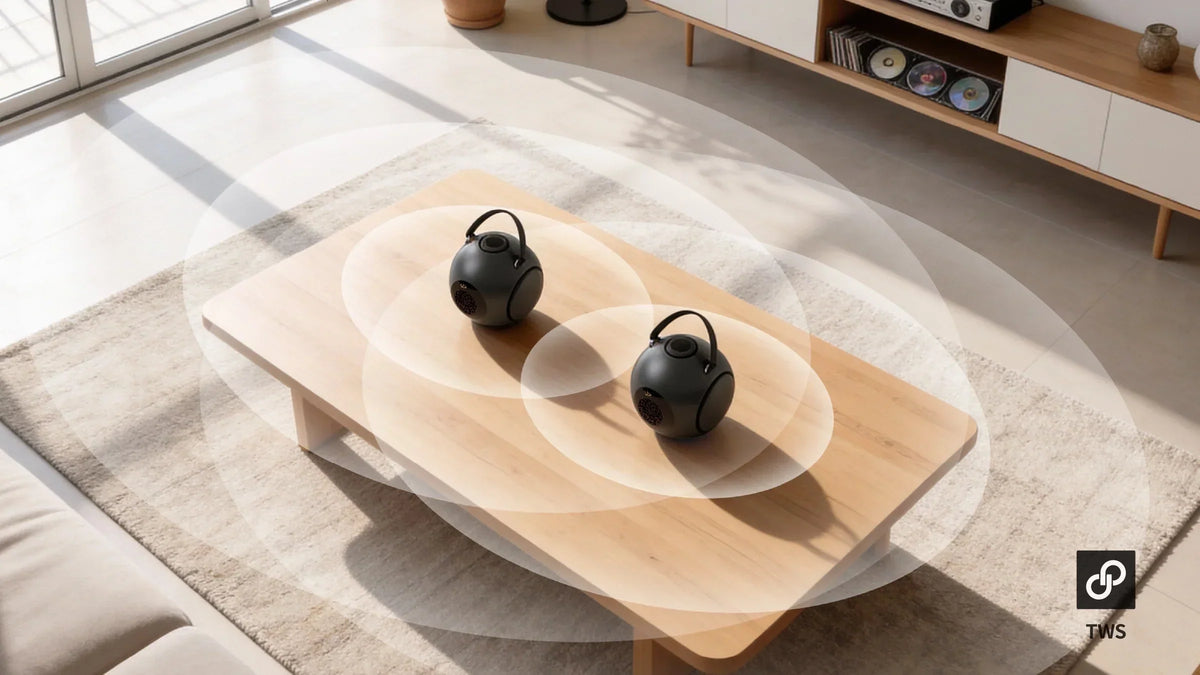
The dB1's spherical architecture is designed around 360° sound dispersion.
This makes it particularly relevant for:
- Living rooms
- Dining areas
- Shared workspaces
- Social gatherings
- Open-plan spaces
- Rooms where listeners move around
Instead of repeatedly turning the speaker toward different listeners, the spherical presentation is intended to distribute sound more consistently around the speaker.
You can explore this concept further in 360° vs. front-firing speakers.
360° vs Conventional Directional Designs
|
Characteristic |
UB+ dB1 |
Conventional Cylinder Speaker |
|
Sound presentation |
360° |
Model-dependent |
|
Preferred listening position |
Less dependent on one direction |
Often more directional |
|
Shared listening |
Designed for multiple positions |
Depends on driver arrangement |
|
Room coverage |
Broad spherical presentation |
Depends on dispersion design |
|
Placement flexibility |
High |
Model-dependent |
The practical difference becomes more noticeable when a speaker is used as part of a room rather than directly in front of one listener.
Midrange and Vocal Clarity
Bass is only one part of a speaker's performance.
A portable speaker also needs to reproduce vocals, guitars, keyboards, percussion, dialogue, and other midrange information without allowing excessive low-frequency energy to dominate the presentation.
The dB1's spherical chamber is designed to manage internal acoustic behavior, while the driver and enclosure operate together as a controlled system.
The goal is not simply to make the speaker produce more bass. It is to create a low-frequency foundation that supports the rest of the frequency range.
The dB1's 40Hz–20kHz frequency response provides a useful indication of the intended operating range, but specifications alone cannot describe the complete listening experience. Room interaction, placement, source material, volume, and listener position also matter.
This is another reason enclosure architecture deserves attention.
When the internal chamber is part of the acoustic design, its behavior influences more than just bass. Internal reflections and pressure distribution can also affect how cleanly the system transitions into the midrange.
Build Quality and Vibration Control
The enclosure also plays a mechanical role.
In the dB1, the two passive radiators are arranged opposite one another. Their symmetrical movement helps counteract mechanical forces generated during operation.
That matters because unwanted cabinet vibration can affect the physical behavior of a speaker and the way it interacts with its supporting surface.
The dB1 therefore treats mechanical balance and acoustic output as connected engineering problems.
The goal is not to eliminate all physical movement. Instead, the architecture is designed so that useful acoustic energy is produced while opposing mechanical forces help maintain stability.
This approach is part of what makes the DoubleBass system different from a conventional single-radiator configuration.
For a broader look at the design philosophy, see Why UB+ Chose the Sphere: The Design and Engineering Story Behind dB1.
Portability and Everyday Use
Cylinder speakers remain extremely practical for portable listening.
Their elongated form can fit easily into bags, backpacks, shelves, and compact spaces. Many are designed around movement, travel, outdoor listening, and quick placement.
The dB1 is portable too, but its design prioritizes acoustic architecture alongside portability.
That creates different use-case priorities.
|
Listening Situation |
UB+ dB1 |
Typical Cylinder Speaker |
|
Shared room |
360° presentation is well suited |
Depends on dispersion |
|
Outdoor use |
Portable with IPX5 protection |
Model-dependent |
|
Travel |
Portable, sphere-oriented design |
Often optimized for compact transport |
|
Multi-listener environment |
360° dispersion |
Model-dependent |
|
Room-filling listening |
Spherical presentation |
Depends on driver layout |
|
Acoustic-design focus |
Spherical chamber and DoubleBass architecture |
Model-dependent |
The important point is that portability does not automatically mean the same thing for every speaker.
A very small cylinder may prioritize minimum size and weight. A larger portable speaker may prioritize output. The dB1 sits between portability and more deliberate acoustic engineering.
Connectivity and Wireless Features
Connectivity is another part of the modern speaker experience.
The dB1 uses Bluetooth 5.3, providing a current Bluetooth connection for compatible source devices. It also supports wired and TF playback according to its product architecture.
Cylinder speakers vary considerably in their wireless capabilities. Depending on the model, they may include Bluetooth, app controls, wireless linking, voice features, or other connectivity options.
The important distinction is that connectivity and acoustic design are separate considerations.
A speaker can have excellent wireless functionality while using a conventional enclosure. Conversely, a speaker can place greater emphasis on physical acoustic engineering while keeping its wireless feature set focused.
|
Feature |
UB+ dB1 |
Conventional Cylinder Speakers |
|
Bluetooth |
5.3 |
Varies |
|
App ecosystem |
UB+ |
Model-dependent |
|
Multi-speaker capabilities |
Model-dependent |
Model-dependent |
|
Wired playback |
Supported according to product architecture |
Model-dependent |
|
TF playback |
Supported |
Model-dependent |
|
Water resistance |
IPX5 |
Varies |
Because wireless features can change between product generations, the exact model should always be checked before making a purchase decision.
Why the Spherical Chamber Changes the Engineering Approach
The dB1's sphere is not simply an alternative shape.
A conventional enclosure often requires engineers to work around the acoustic consequences of flat, parallel, or elongated internal surfaces. A spherical chamber changes the way air pressure is distributed within the enclosure.
The Helmholtz-inspired chamber provides the acoustic volume in which the downward-firing driver operates.
The driver energizes the air inside the sphere. Internal pressure builds around the chamber, and the passive radiators respond to that pressure.
This creates a chain of mechanical and acoustic events:
Driver movement → spherical air loading → internal pressure → passive-radiator movement → low-frequency acoustic output
The advantage of this approach is that the bass system is not dependent on a single component.
The chamber, driver, and radiators all contribute.
That is also why the dB1 should not be understood simply as a “Bluetooth speaker with a round body.” Its physical form is directly connected to its acoustic function.
Where a Cylinder Speaker May Make More Sense
A comparison should also acknowledge where conventional cylinder designs can be useful.
Their compact elongated shape can be extremely convenient for travel. Some models are designed specifically for small bags, cup holders, shelves, or outdoor environments.
Cylinder speakers can also offer different feature combinations, including:
- Compact dimensions
- Lightweight construction
- Different IP ratings
- App-based controls
- Voice features
- Multi-speaker linking
- Different battery capacities
- Various driver configurations
The choice therefore depends on what matters most in the listening environment.
If minimum size is the main requirement, a small cylinder may be more practical. If broad room coverage and spherical acoustic architecture are priorities, the dB1 presents a different option.
This is why comparing form factors is more useful than simply asking which design is “better.”
Which Design Fits Different Listening Environments?
Living Room
The dB1's 360° presentation can be useful when listeners are distributed around a room rather than sitting directly in front of the speaker.
Its spherical form also makes placement less dependent on a single listening direction.
Outdoor Listening
The dB1's IPX5 rating provides protection against water jets and splashes. It is suitable for portable use, but IPX5 does not mean the speaker is designed to be submerged.
Cylinder speakers range from basic indoor-portable products to heavily protected outdoor models, so the specific IP rating matters.
Shared Spaces
A 360° speaker can be useful when people sit or move around different sides of the speaker.
This is where the dB1's spherical architecture becomes particularly relevant. Instead of directing the speaker toward one seating position, the system is designed to distribute sound around itself.
Home Office
A compact speaker needs to deliver enough clarity for music, podcasts, calls, and background listening without requiring constant repositioning.
The dB1's room-oriented dispersion makes it suitable for spaces where the listener may move between a desk, nearby seating, or other parts of the room.
Critical Listening
For listeners interested in speaker engineering, the dB1 offers a distinctive physical approach to acoustic loading and mechanical bass reproduction.
However, critical listening is influenced by the room, placement, source material, listening position, and the complete audio system—not just enclosure geometry.
What Should You Compare Before Buying?
Instead of comparing speakers based only on marketing terms, examine the underlying characteristics.
|
Priority |
What to Examine |
|
Bass |
Frequency response, driver excursion, passive-radiator/port design, enclosure volume |
|
Room coverage |
Dispersion pattern and driver orientation |
|
Portability |
Physical size, weight, battery system |
|
Outdoor use |
Actual IP rating |
|
Wireless audio |
Bluetooth version and supported features |
|
Multi-speaker listening |
Connection method and ecosystem |
|
Acoustic engineering |
Driver arrangement, chamber geometry and mechanical design |
|
Convenience |
App, controls and automatic functions |
|
Listening environment |
Room size, placement and number of listeners |
This gives you a much more useful framework than simply choosing a speaker because it has the highest wattage or the most impressive bass description.
Who Should Consider the UB+ dB1?
The UB+ dB1 DoubleBass is particularly interesting for listeners who prioritize:
- A distinctive spherical acoustic architecture
- 360° sound dispersion
- Controlled low-frequency reproduction
- Mechanical rather than purely electronic approaches to bass reinforcement
- Symmetrical passive-radiator design
- A speaker that works naturally in shared listening environments
- A combination of industrial design and acoustic engineering
The dB1 can be especially relevant when the speaker is expected to function as part of the room rather than simply point toward one listener.
Its spherical design also gives it a different visual presence from the elongated cylinder format commonly used in portable audio.
For another look at the difference between speaker geometries, read Spherical vs. Box Speakers: Sound Comparison.
Why the Sphere Is More Than a Visual Design Choice
The most important distinction between the dB1 and conventional cylinder speakers is that the sphere is not simply a visual signature.
The spherical chamber, downward-firing driver, dual opposing passive radiators, and 360° sound radiation are connected elements of one acoustic system.
That approach reflects a broader principle in speaker engineering: enclosure geometry, driver behavior, mechanical vibration, and acoustic loading cannot always be treated as separate problems.
The dB1 combines them into one architecture.
The result is a speaker designed around the behavior of air inside and around the enclosure rather than simply placing conventional components inside a different-looking cabinet.
For a deeper look at the engineering philosophy behind the design, read Why UB+ Chose the Sphere: The Design and Engineering Story Behind dB1.
Frequently Asked Questions
Is a spherical speaker different from a cylinder speaker?
Yes. The primary difference is enclosure geometry and how that geometry interacts with the acoustic system. A spherical speaker can distribute internal pressure differently from an elongated cylindrical enclosure. The actual performance still depends on the driver, chamber volume, passive radiators, tuning, and other components.
Why does UB+ use a spherical enclosure?
The dB1 uses a spherical acoustic chamber as a central part of its design. The geometry is intended to support more even internal pressure distribution while reducing problematic internal resonances and working with the downward-firing driver and opposing passive radiators.
Does the dB1 have strong bass because it is round?
The shape alone does not determine bass performance. The dB1's low-frequency behavior comes from the interaction of its spherical chamber, 4.5-inch driver, long-stroke design, dual passive radiators, approximately 3.5× passive-radiator surface area, and overall system tuning.
Is the dB1 suitable for outdoor use?
Yes. The dB1 has an IPX5 rating, meaning it is designed to withstand water jets and splashes. IPX5 does not mean the speaker is safe to submerge.
Is a 360° speaker useful in a shared room?
A 360° speaker can be useful when listeners are positioned around different sides of the speaker. Instead of requiring one preferred listening direction, the dB1 is designed to distribute sound around the enclosure, making it suitable for shared rooms and spaces where people move around.
Final Thoughts
The comparison between the UB+ dB1 and conventional cylinder speakers is ultimately a comparison between different approaches to portable wireless audio.
Cylinder speakers remain popular because their elongated form factor is practical, portable, and easy to integrate into compact products. Different models use different combinations of drivers, passive radiators, DSP, batteries, and enclosure materials to achieve their intended performance.
UB+ takes a more architecture-driven approach with the dB1.
Its spherical acoustic chamber, downward-firing mid-bass driver, opposing passive radiators, and 360° sound presentation are designed as interconnected parts of the speaker rather than isolated features.
That makes the dB1 particularly interesting for listeners who want to look beyond conventional portable speaker shapes and understand how acoustic geometry, mechanical balance, bass architecture, and sound dispersion work together.
For anyone comparing a Bluetooth sphere speaker with conventional cylinder designs, the important question is not simply which shape looks better.
It is how the enclosure, driver, acoustic loading, passive radiators, and dispersion pattern fit the way you actually listen.
Explore UB+ Speakers
→ Explore the UB+ dB1 DoubleBass


Commenta
Questo sito è protetto da hCaptcha e applica le Norme sulla privacy e i Termini di servizio di hCaptcha.