
Choosing a speaker is no longer simply about finding the highest wattage, the biggest driver, or the deepest bass specification. The more useful question is: How will the speaker actually behave in the space where you listen?
A living room, apartment, home office, bedroom, dorm, or outdoor area can create very different listening conditions. You may sit directly in front of a speaker during focused listening, move around the room while working, or have several people listening from different positions.
That is why speaker form factor matters.
Bookshelf speakers, portable Bluetooth speakers, and 360° wireless speakers are built around different assumptions about placement, sound distribution, bass reproduction, and everyday use. Understanding those differences makes it easier to choose a system that fits your room instead of choosing one based only on specifications.
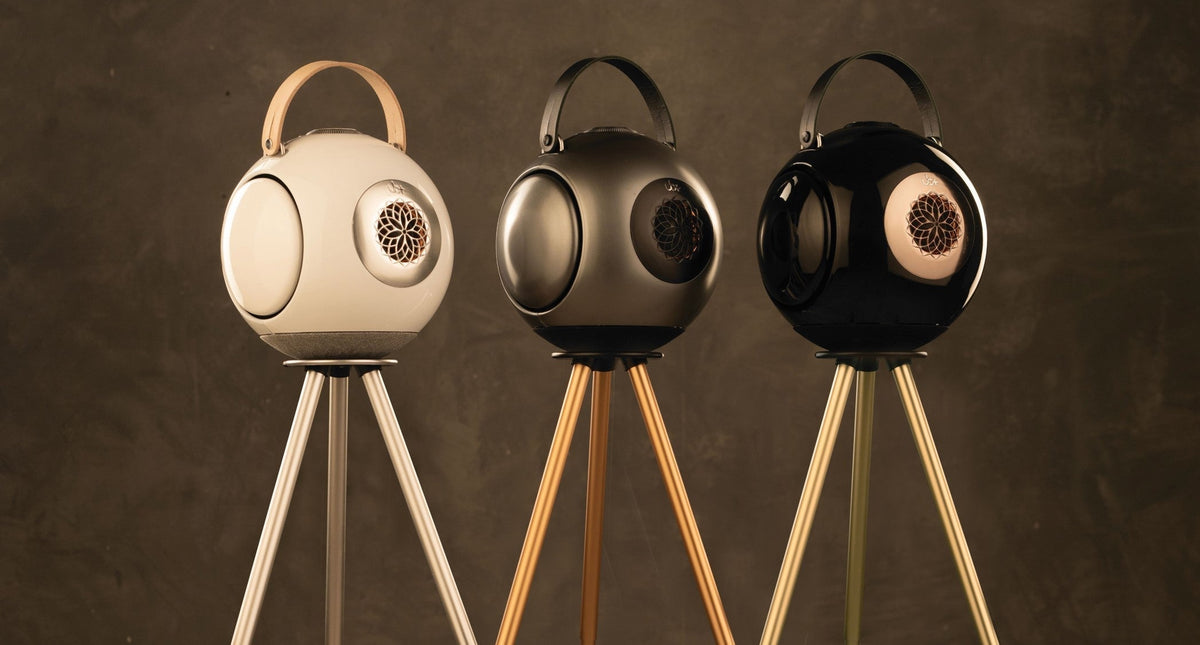
The UB+ dB1 DoubleBass takes a different approach from conventional compact speakers. Its spherical enclosure, downward-firing mid-bass driver, symmetrical passive-radiator system, and 360° sound presentation are designed to work together as an acoustic system.
For listeners researching bookshelf vs portable speakers, 360° Bluetooth speakers, or a round wireless speaker, the important comparison is not simply size or appearance. It is how each architecture interacts with the room.
Bookshelf Speakers: Designed Around a Listening Position

Bookshelf speakers come from traditional hi-fi design, where the speaker system is usually positioned around a relatively fixed listening location.
A typical bookshelf setup uses two speakers separated from one another to create left-right stereo imaging. When the speakers are correctly positioned relative to the listener, this arrangement can provide precise imaging, channel separation, and detailed reproduction.
The trade-off is placement.
Distance from the wall can influence bass response. The spacing between the speakers affects stereo imaging. The listener's position can change the perceived balance between the left and right channels.
That is not necessarily a limitation. It is simply the result of designing a system around a defined listening geometry.
For someone who has a dedicated listening room, a fixed entertainment area, or a preferred chair or sofa, bookshelf speakers can fit naturally into the environment.
But modern rooms often serve several purposes at once.
A living room may also be a workspace. A dining area may share the same open floor plan. A home office may become a relaxation space at night. In these situations, people do not remain in one listening position.
That is where portable and 360° speaker designs become particularly relevant.
Portable Bluetooth Speakers: Sound That Moves With You

The appeal of a portable Bluetooth speaker is straightforward: the speaker does not have to remain in one place.
You can move it from a desk to a kitchen counter, from a bedroom to a balcony, or from indoors to an outdoor gathering. Bluetooth removes the need for a permanent wired connection to the source device, making portable speakers particularly convenient for everyday listening.
But portability creates engineering compromises.
A compact speaker has limited enclosure volume. The designer has to balance driver size, battery capacity, physical dimensions, efficiency, maximum output, bass response, and heat management within a relatively small package.
This is why two portable speakers that appear similar on paper can produce very different results.
Some compact systems use DSP to modify frequency response and increase the perception of bass from a small enclosure. DSP is an important tool in modern speaker engineering, but digital processing cannot completely change the physical relationship between enclosure volume, driver excursion, acoustic loading, and air movement.
The enclosure still matters.
That is one reason the development of spherical Bluetooth speakers is worth examining separately from conventional portable designs.
360° Wireless Speakers: When the Room Becomes the Listening Area

A conventional front-facing speaker generally creates a preferred listening direction.
That can be useful when the listener is sitting directly in front of it. But it becomes less convenient when several people are listening from different locations.
A 360° wireless speaker approaches the problem differently.
Instead of making one listening position the primary target, the system is designed to distribute sound around the speaker. This can be useful in living rooms, kitchens, shared offices, dining areas, and social spaces where listeners move naturally.
Imagine music playing while you prepare food in the kitchen. Then you walk into the dining area. Later, someone sits on the other side of the room.
With a highly directional speaker, your position relative to the speaker changes the listening experience.
A 360° architecture is intended to make that movement less important.
This is one reason 360° Bluetooth speakers have become an interesting category for modern home listening. The goal is not necessarily to replace every traditional stereo system, but to provide a different relationship between the speaker and the room.
Why the Spherical Enclosure Matters

The UB+ dB1 DoubleBass takes the 360° concept further by making the spherical enclosure itself part of the acoustic architecture.
Traditional box-style cabinets contain flat internal surfaces. Depending on their dimensions and construction, internal reflections and standing-wave behavior can become factors that engineers need to manage.
A sphere provides a fundamentally different internal geometry.
The UB+ dB1 DoubleBass uses a spherical acoustic chamber inspired by the principles of the Helmholtz resonator. In a Helmholtz-based acoustic system, the relationship between an enclosed volume of air and an opening or radiating element can be used to control resonance.
UB+ applies the underlying acoustic concept to its spherical chamber.
The intention is not simply to make a speaker that looks different. The enclosure is designed to influence how air pressure develops inside the speaker and how acoustic energy is transferred through the system.
For a deeper look at this design philosophy, see How Spherical Speaker Design Changes Modern Home Audio.
This is an important distinction when evaluating a round Bluetooth speaker. The shape itself does not automatically make a speaker sound better. What matters is how the geometry, driver, air volume, radiators, and tuning work together.
The Relationship Between Enclosure Volume and Bass
Low-frequency reproduction is one of the most difficult challenges in compact speaker engineering.
Bass requires the movement of air. Yet portable speakers have relatively small enclosures and limited physical space for drivers and supporting components.
Engineers can approach the problem through several methods:
- Bass-reflex ports
- Passive radiators
- DSP and equalization
- Larger driver excursion
- Specialized acoustic chambers
- Different enclosure geometries
The dB1 DoubleBass combines several of these engineering considerations into one system.
Its downward-firing mid-bass driver energizes the internal spherical chamber. The resulting air pressure interacts with two large passive radiators positioned on opposite sides of the enclosure.
The passive radiators provide additional radiating surface for low-frequency energy without requiring a conventional port.
The combined passive-radiator surface area is approximately 3.5 times the active woofer area, giving the system substantial radiating area relative to the driver.
This architecture is part of what makes the dB1 different from a conventional compact portable speaker.
What Makes the UB+ dB1 DoubleBass Different?
The dB1 should not be understood simply as a portable speaker placed inside a spherical cabinet.
Its acoustic components are designed to function together.
Spherical Acoustic Chamber
The spherical enclosure creates a different internal acoustic environment from a conventional rectangular cabinet.
Its curved geometry supports more symmetrical internal pressure distribution and is intended to reduce problematic internal reflections and standing-wave behavior.
Downward-Firing Mid-Bass Driver
Instead of firing directly toward a listener, the dB1's mid-bass driver fires downward into the spherical chamber.
The internal air volume therefore becomes part of the acoustic process.
The driver, chamber, and passive radiators work together rather than treating the enclosure as passive packaging around the driver.
Dual Symmetrical Passive Radiators
The DoubleBass architecture uses two passive radiators positioned opposite each other.
Their symmetrical movement contributes to low-frequency output while helping balance mechanical forces within the enclosure.
This mechanical approach is an important part of the dB1's design philosophy. Rather than attempting to create bass only by increasing electronic bass gain, the system uses the movement of air and the physical architecture of the speaker.
360° Sound Distribution
The spherical form also supports the dB1's 360° presentation.
Instead of requiring a single front-facing listening direction, the speaker is designed to distribute sound around the surrounding space.
For more detail on the difference between these approaches, see 360° vs. Front-Firing Speakers.
Bookshelf vs Portable vs 360°: How They Behave in a Living Room
The living room is one of the clearest examples of why speaker design matters.
A bookshelf system can provide excellent stereo imaging when positioned correctly. The speakers can be placed on stands or furniture and aimed toward the primary seating area.
But many living rooms are not dedicated listening rooms.
People sit on different sofas. Someone may be reading in a corner. Another person may be walking around. A television, dining area, or workspace may share the same room.
A 360° speaker changes the placement equation.
Instead of aiming the speaker toward one seat, you can position it within the room and allow its broader sound distribution to serve multiple listening positions.
The result is a different type of listening experience: less dependent on a precise sweet spot and more focused on filling the surrounding environment.
In a Home Office
Home offices create another interesting use case.
A person may listen to music for several hours while working, but they are rarely sitting perfectly still.
You may move from the desk to a shelf, stand while taking a call, or walk around the room between tasks.
A conventional front-facing speaker can still work well, but its listening angle changes as you move.
A 360° wireless speaker is naturally suited to this type of environment because the speaker does not have to be constantly repositioned toward the listener.
For smaller offices, a compact portable speaker can also be useful because it takes up little desk space.
The important distinction is that a portable speaker and a 360° speaker solve slightly different problems. One emphasizes mobility; the other emphasizes broader sound distribution.
In an Apartment
Apartment living can make speaker selection more complicated.
Rooms are often multifunctional, furniture placement can be limited, and there may not be enough space for a conventional stereo arrangement.
A portable speaker reduces installation requirements.
A 360° speaker can go a step further by reducing the importance of speaker orientation.
Bass also requires careful consideration.
A small room can make excessive low-frequency energy feel more prominent because walls and nearby surfaces interact with the sound. The objective is therefore not simply maximum bass output. Controlled low-frequency reproduction can be more useful than exaggerated bass.
The dB1's spherical chamber and DoubleBass architecture are designed around this principle of controlled acoustic energy rather than relying solely on aggressive electronic bass enhancement.
For another perspective on enclosure architecture, see Spherical vs. Box Speakers: Sound Comparison.
Outdoors: Where Sound Distribution Becomes More Important
Outdoor listening removes many of the acoustic boundaries present indoors.
There are no nearby walls surrounding the speaker in the same way, and listeners can be positioned around the system rather than directly in front of it.
This makes portability important, but it also makes sound distribution relevant.
A front-facing portable speaker can work well when the group is positioned in front of it. A 360° speaker offers a different approach by distributing sound around the speaker.
The dB1 also has an IPX5 water-resistance rating, making it suitable for environments where it may encounter splashes or water jets. IPX5 does not mean the speaker is designed to be submerged.
Its combination of portability, spherical architecture, and broad sound distribution makes it relevant for outdoor listening where the speaker's position may change throughout the session.
In a Bedroom or Dorm Room
Small rooms often reward simple setups.
A traditional bookshelf system may require two speakers, additional cables, suitable placement, and enough furniture or floor space to position everything correctly.
A portable wireless speaker eliminates much of that complexity.
A small round Bluetooth speaker can also be positioned in different parts of the room without requiring a permanent installation.
For someone who wants music while studying, relaxing, reading, or getting ready, the ability to move the speaker without redesigning the room can be more important than maximum stereo separation.
The dB1 is larger than an ultra-compact travel speaker, but its spherical architecture is designed around room-filling sound rather than simply minimizing physical size.
Why Enclosure Design Matters More Than a Spec Sheet Suggests
Speaker comparisons often focus on easy-to-read specifications:
- Wattage
- Driver size
- Frequency response
- Battery life
- Bluetooth version
- Water resistance
- Weight
These numbers are useful, but they do not tell the entire acoustic story.
Two speakers can have similar driver sizes and completely different acoustic behavior because their enclosure volume, internal geometry, passive-radiator area, driver orientation, and tuning are different.
The enclosure determines how air behaves.
The driver determines how electrical energy becomes mechanical motion.
The passive radiator or port determines how low-frequency energy is coupled to the outside environment.
DSP can then be used to refine the final response.
These elements should be considered as a system rather than isolated specifications.
A Closer Look at the dB1 Acoustic System
The dB1's engineering becomes easier to understand when its components are viewed as a connected system.
The 4.5-inch mid-bass driver provides the primary active acoustic energy. Its long-stroke design and oversized 90 mm neodymium magnet support the driver's ability to move air.
The driver fires downward into the spherical chamber.
The chamber then distributes internal pressure around the enclosure.
The two passive radiators respond to this pressure and contribute additional low-frequency output.
Because the passive radiators are positioned opposite each other, their mechanical movement is symmetrical.
This is the DoubleBass concept: use the movement of air and mechanical balance as part of the bass system instead of treating bass as an electronic effect added after the fact.
The dB1 is specified for a frequency response reaching approximately 40Hz–20kHz, with a maximum sound pressure level of approximately 93dB SPL.
The result is a speaker architecture designed around physical acoustics as much as digital processing.
Bookshelf vs Portable vs 360°: Which Design Fits Different Priorities?
|
Speaker Type |
Primary Strength |
Placement |
Sound Distribution |
Best Fit |
|
Bookshelf speakers |
Stereo imaging and focused listening |
Relatively fixed |
Primarily directional |
Dedicated listening areas |
|
Portable Bluetooth speaker |
Mobility and convenience |
Highly flexible |
Usually model-dependent |
Travel, desks, casual listening |
|
360° wireless speaker |
Broad room coverage |
Flexible |
Designed around wider distribution |
Shared rooms and moving listeners |
|
UB+ dB1 DoubleBass |
Spherical acoustic architecture + room-filling sound |
Flexible |
360° presentation |
Home, shared spaces, flexible listening |
This comparison illustrates why there is no single form factor that suits every room.
The important question is what you need the speaker to do.
Bookshelf vs Portable: When Is Portability More Important?
A bookshelf system makes sense when the listening environment is relatively stable.
If your speakers remain in the same position and you spend most of your listening time in one area, the benefits of a dedicated stereo setup can be significant.
Portable speakers become more practical when your listening environment changes throughout the day.
If you want one speaker that moves from room to room, portability is a major advantage.
But there is another consideration: how you want sound to interact with the room once the speaker is there.
That is where the distinction between a conventional portable speaker and a 360° design becomes important.
Portable vs 360°: Mobility or Coverage?
These two categories can overlap, but their design priorities are different.
A portable Bluetooth speaker is primarily about freedom from a fixed location.
A 360° speaker is about freedom from a fixed listening direction.
The dB1 combines both ideas.
You can move it around like a portable wireless speaker, but its spherical architecture is designed so that listeners do not have to remain directly in front of it.
For shared rooms and flexible listening, that combination can be useful.
Why the Sphere Is More Than a Visual Choice
The appeal of a sphere can initially look purely aesthetic.
But the acoustic reasoning is more significant.
The spherical enclosure allows the internal air volume to become a central part of the speaker's design. The downward-firing driver energizes that volume, while the passive radiators respond to the resulting pressure.
This means the enclosure is not simply holding the components together.
It is participating in the acoustic process.
That principle is explored in greater depth in Why UB+ Chose the Sphere: The Design and Engineering Story Behind dB1.
For buyers comparing sphere speakers vs box speakers, this is an important distinction. Shape by itself does not guarantee better sound; the engineering relationship between shape and the rest of the acoustic system is what matters.
Which Speaker Fits Your Lifestyle?
The right category depends on how you use your room.
Choose Bookshelf Speakers If:
You want a more traditional stereo listening arrangement, have a stable furniture layout, and spend significant time listening from a defined position.
Choose a Portable Bluetooth Speaker If:
You prioritize mobility, compact size, and the ability to take your speaker from one location to another.
Consider a 360° Wireless Speaker If:
You frequently move around the room, share music with multiple listeners, or want sound that is less dependent on one listening direction.
Consider a Spherical Speaker Like the dB1 If:
You want portable wireless listening combined with a spherical acoustic chamber, 360° sound presentation, and a mechanically engineered bass system.
Frequently Asked Questions
Are bookshelf speakers better than portable Bluetooth speakers?
They are designed for different listening situations. Bookshelf speakers generally prioritize stereo imaging and fixed placement, while portable Bluetooth speakers prioritize mobility and convenience. The appropriate choice depends on your room and listening habits.
What is the advantage of a 360° Bluetooth speaker?
A 360° Bluetooth speaker is designed to distribute sound more broadly around the speaker. This can be useful when listeners are positioned in different areas of a room rather than sitting directly in front of the speaker.
Does a spherical speaker automatically sound better?
No. The shape alone does not determine sound quality. The driver, enclosure volume, internal geometry, passive radiators, acoustic tuning, DSP, and overall system design all contribute to performance.
Why does the UB+ dB1 use a spherical enclosure?
The dB1 uses a spherical chamber as part of its acoustic architecture. Its design combines the chamber with a downward-firing mid-bass driver and two opposing passive radiators to manage internal air pressure and low-frequency output.
Is the UB+ dB1 suitable for outdoor listening?
The dB1 is portable and has an IPX5 water-resistance rating, meaning it is designed to withstand water jets and splashes. It is not designed to be submerged.
Final Thoughts
The comparison between bookshelf vs portable vs 360° speakers ultimately comes down to how you want your speaker to interact with your room.
Bookshelf speakers are built around focused stereo listening and deliberate placement. Portable Bluetooth speakers prioritize mobility and convenience. 360° wireless speakers take a different approach by making broader sound distribution part of the design.
The UB+ dB1 DoubleBass combines portable wireless use with a spherical acoustic architecture. Its Helmholtz-inspired chamber, downward-firing mid-bass driver, dual symmetrical passive radiators, and 360° sound presentation are designed to work together rather than function as isolated features.
That makes the dB1 particularly relevant for listeners who want a speaker that can move with them while still functioning as part of the surrounding space.
The right speaker is ultimately the one that matches your room, your listening position, your mobility needs, and the way you actually use music every day.
Explore UB+


留言
此網站已受到 hCaptcha 保護,且適用 hCaptcha 隱私政策以及服務條款。